Wednesday, 28 December 2022

JUDICIAL PERFIDIES-26

 Dr A P J Abdul Kalam, the all time favorite and one of the most beloved Presidents of this country, had once famously quipped: dreams are not what you see in sleep, dreams are what drive you to achieve your ambitions when you are awake.


I must admit, I seem to have gone beyond. My dream, of seeing a transparent and accountable judiciary, has taken me to a state of sleep deprivation or insomnia. Of late my wife has been complaining about me talking in my sleep. The words she has recognized are like ‘unfair’, ‘injustice’, ‘stupid’, ‘selfish’ etc.


That put me at a loss in deciding whether I should continue with my question ‘who will judge the judges’ and assertion that ‘contempt of court is anathema in a democracy, democracy demands Contempt of Citizen (Prevention of) Act’ or retire. Would it result in the proverbial slip between the cup and lip? Or would it be like the proverbial dog’s tail that can never be straightened?


Anyhow, when the debate over the appointment of judges to the higher judiciary is heating up, I have decided to take a break. For now I shall refrain from dealing with case laws that question the credibility and integrity of the justice delivery system headed by the judiciary.


Here I shall narrate how the total failure of our judiciary has led to the collapse of the system of governance itself. This is notwithstanding Prime Minister Narendra Modi’s fast paced creation of infrastructure, generation of employment and access to basic facilities offered to the marginalized. 


The problem is with delivery of government services, in its myriad forms, to citizens, in general. I, for one, believe that the failure of the judiciary is being exploited by the public servants in the other organs of governance and driving citizens to take law into their own hands. It is now the proverbial question of which came first: the chicken or the egg?


On 03/12/2022 the media reported a tall claim- we are ‘most transparent institution’- made by some judges of the apex court. The fact is they are not. Absolutely not. Let us analyze it in the context of compliance with the Right to Information Act.


The first and foremost fact is neither the apex court nor the information commissions have complied with the mandate of Section 4(1)(b) of the RTI Act whereby all public authorities are required to disclose certain information about their structure, employees, functions , remuneration, contact information, documents held, procedure followed etc. 


I usually seek information on compliance with two of these- the directory of the public servants and their remuneration- which are required to be disclosed under Sec4(1)(b) (ix) and(x).  It is my simple yardstick for measuring the transparency of any public authority.


The data downloaded from the respective websites of the Kerala State Information Commission (KSIC), Central Information Commission (CIC) and the  Supreme Court (SC),  are shown in the screenshots 1 to 5 provided at the end of this part.  The facts to be noted are:

Ø  The KSIC had published the information correct enough to pass muster till 2011

Ø  The CIC had published the information correctly till 2012.

Ø  The apex court had not published the information pertaining to judges even in 2021.

Ø  The CIC has reduced its disclosure to practically nothing in 2022.

Ø  The KSIC has totally done away with disclosures mandated under Section4(1)(b) in 2022


Certain provisions of the RTI Act appear to be designed to subvert the law itself. It begins with the process of selection of the information commissioners. It is done by a committee of three comprising the PM/CM, another minister from the respective cabinet and the Leader of the Opposition. With the absence of a mandate for unanimity, the Leader of the Opposition is just a dummy in the selection process.


So far, I have come across just one case of such a selection process being challenged. This happened when a retired bureaucrat, P J Thomas, facing trial in the Palmolien Import Scam, was appointed as the Central Vigilance Commissioner. The apex court set aside his appointment in 2011. (But the case in which he is an accused is still pending. The alleged offence was committed in 1992.)


More importantly, the allegation of nepotism being hurled at the judiciary and its Collegium, is relevant in the case of these appointments too. It is generally bureaucrats who are closer to the power centers, who are seen making it as information commissioners and members of other quasi judicial bodies.


Given the fact that the task of the information commissioners is simpler than that of a munsif, the status, pay and perks given to them make it lucrative as sine cures for retiring babus; of course, at unwarranted and exorbitant cost to the exchequer.  


The law has explicitly barred certain information from being disclosed as well as kept certain organizations, as a whole, out of purview of the RTI Act. With that, all that the information commissioners have to do, on receipt of an appeal, is to ask just two questions beginning with: have all the information sought, which can be disclosed, been provided or not? If yes, have they been provided within the specified time frame? If not, is there any legally valid reason for the delay or denial? It is now for the information commissioner to get these reasons from the Public Information Officer, through a show cause notice. In the words of the law, be given a reasonable opportunity of being heard before any penalty is imposed on him.


The penalty is also specified-Rs 250/- per day of delay after 30 days of receipt of the application. 


However, what we find is that even when the information commissioners order the PIOs to provide the information that had not been provided, he desists from imposing the mandated penalty. It leads not only to subversion of the law but also to financial loss to the State. Worse, apprehensions of corruption also become wholly justified, not only in the broadest sense that Advocate Prashant Bhushan meant while alleging that 8 chief justices of India were corrupt, but also in its narrowest terms.  The subversion of law is to such an extent that even when no information has been provided the information commissioners brazenly record that all available information has been provided and close the case.


Let me narrate an example.


I was travelling by train to Thiruvananthapuram. I had only an RAC (Reservation against Cancellation) ticket but I was the first on the RAC list. That meant even if there had been just one cancellation I should have got a berth. However, even after one hour of the departure from the train there was no allotment of berth. So, when the TTE (Travelling Ticket Examiner) came around next time, I approached him with a request that I should be given a certificate that I had not been allotted a berth. The reason was simple. The RAC tickets are issued against full cost of a sleeper ticket, but when you are not allotted a berth it turns out to be just a sitting accommodation in the Sleeper Coach. So I wanted to claim refund of the excess cost and if denied follow it up with appropriate authorities.  Suffice to say that the TTE did not give the certificate sought but allotted a berth within the next 15 minutes.


Now, the issue could not be left at that. The objective of the RTI Act is to contain corruption and I wanted to check if anybody else had been allotted a berth before me (a sign of corruption, if not in its narrowest sense, surely in its widest sense). So I sought copies of the reservation chart with the data updated by the TTE.  Horror of horrors, the public authority, that is the Southern Railway Divisional Office at Thiruvananthapuram, demanded Rs 750/- per PNR number against Rs 2/- per page prescribed in the RTI Rules of the Central Government. The 2nd appeal filed on 16/04/2014 was dismissed by the information commissioner, Bimal Julka, on 14/07/2016.


Section 219 of the Indian Penal Code does provide for prosecuting such public servants and when convicted they are liable to imprisonment for 7 years. Just imagine what would happen if each information commissioner is prosecuted for every wrong verdict he delivers. But who will prosecute these delinquent and corrupt information commissioners when the judiciary takes decades to give verdict even in rape and murder cases?


There is also this unwarranted hurdle of seeking permission for prosecution of these treacherous public servants from others of their ilk. Just imagine the ridiculousness of the public needing to take permission from a public servant to prosecute another public servant. And even in the rare cases you get the permission, the public servant will defend his case at taxpayer’s money where as the complainant will have to drain his own resources. Great level playing field, isn’t it?


There have been cases where PIOs penalized by the information commissioners have appealed to the high courts, at taxpayers’ cost. In one such case at least, a high court had ruled that the appellant (the penalized PIO) will have to bear the expenses himself and tax payers’ money cannot be wasted on it. But, has any competent authority followed the logic and incorporated it in their rules?  To the best of my knowledge and belief, it is a definite no.


The RTI Act is a very simple and unambiguous law. It, to my mind, is the only pro-democracy and citizen friendly law in the country. It empowers the President (Sec 14(3)(d)) and the Governors  in the respective states (Section 17(3)(d ))to order removal of information commissioners who are, in their opinion, unfit to continue in office by reason of infirmity of mind or body.  But what do you do when these high offices act only as post offices? Let me narrate two instances.

A judgment published as 2004(3) KLT 1073 had observed that the President of the Kerala State Consumer Disputes Redressal Commission, a former judge of the same court, had mislead the court in the matter of the President having declared holidays for the Commission in line with the holidays declared by the High Court. Since no action for perjury had been initiated by the court a complaint was filed with the National Consumer Dispute Redressal Commission by an umbrella organization of consumer rights activists, Save Consumer Courts Action Council. Later an application under the RTI Act was submitted to get information on action taken on the complaint.  The reply advised the matter to be taken up with the Government of Kerala.  Since that could not be accepted as an action taken on the complaint the matter finally landed with the Chief Information Commissioner, Wajahat Habibulla. He, without applying his mind (not unusual with our babus), sent it to the Kerala State Information Commission. The fiasco was brought to his notice and the appeal was resubmitted. He, shockingly, forwarded it also to the KSIC. A complaint was submitted to the President to remove him under Section 14(3)(d) of the RTI Act. An application under the RTI Act for information on action taken revealed that it had been forwarded to the Department of Personnel and Training for action at their end and informing the complainant.


Similarly, a complaint was submitted to the Chief Minister of Kerala listing a number of defects and deficiencies in the functioning of the KSIC and requesting for action under Section 26 and 27 of the RTI Act. Of these, Section 27(2)(e) and (f) empowers the competent authority to prescribe the procedure to be adopted by the State Information Commission in deciding the appeals and any other matter which is required to be, or may be prescribed. This was important since the Commission was not even disposing of complaints and appeals on a first come, first served basis, leave alone directing delinquent PIOs to provide the information sought or penalizing them, as mandated by the law.  Unfortunately, after persistent follow up the only response received was from the Department of General Administration stating that since the Information Commission was an autonomous entity the Government cannot interfere in its functions. 


Can one imagine that there can be chaos even in the matter of language used? Section 6(1) of the RTI Act states that A person, who desires to obtain any information under this Act, shall make a request in writing or through electronic means in English or Hindi or in the official language of the area in which the application is being made. Now, should there be any doubt about the language in which appeals are to be submitted or replies are to be given? Just imagine a citizen from Delhi seeking information from a public authority in Kerala and applying in English and getting a reply in Malayalam. In any case, we are following a three language formula for our high school education and no public servant handling documents can be expected to be having education less than SSLC. But even in fully literate Kerala, it is common experience that most applications/appeals in English are replied to in Malayalam.


The malicious nature of functioning of the public authorities can be seen even in quoting the references to communications from the applicant /appellant. From PIOs to the Secretary of the Commission, they will only refer to the date of the application/appeal, sometimes not even the date mentioned in the document but the date of its receipt by the PIO/appellate authority, whereas they would refer to the complete file number and date of the communication from public authorities. (See Screenshot-6) Even specific requirement of quoting the file number is maliciously neglected by the PIOs and the appellate authorities.

The latest scam in the matter of implementing the RTI Act in Kerala is that the KSIC has devised a new, illegal and abhorrable means of disposing of complaints and appeals. One fine day the appellant gets a letter from the commission just referring to the date of submission of application and the public authority and seeking to know if the contentions averred in the appeal are persisting and if persisting it should be intimated to the Commission within 10 days, failing which the appeal would be closed. Adding insult to injury, on the letter head will be given an e mail id that does not work either.


There is more to the methods by which this simple pro-democracy, citizen friendly law is being subverted by the public authorities, including the information commissions and the courts.  More on this later.


P M Ravindran/ raviforjustice@gmail.com                                               05 December 2022


Screenshot-1. Disclosure under Sec 4(1)(b)(x) of the RTI Act by Kerala State Information Commission as on 01/10/2011

Screenshot-2. Disclosure under Sec 4(1)(b)(x) of the RTI Act by the Central Information Commission as on 14/05/12, accessed on 19/01/2014.
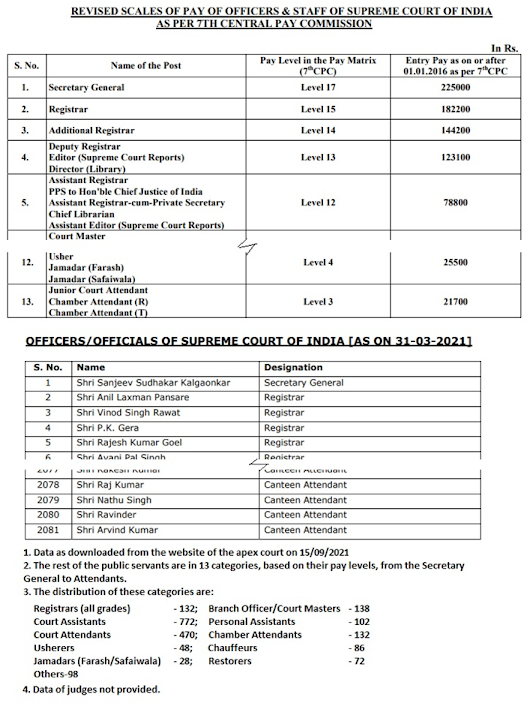

Screenshot-3. Disclosure under Sec 4(1)(b)(x) of the RTI Act by the Supreme Court of India

 Screenshot-4. Disclosure under Sec 4(1)(b)(x) of the RTI Act by the Central Information Commission as accessed on 04/12/2022

Screenshot-5. Disclosure under Sec 4(1)(b)(x) of the RTI Act by the Central Information Commission as accessed on 04/12/2022

Screenshot-6. Notice sent by Kerala State Information Commission to the FAA in my 2nd appeal.


JUDICIAL PERFIDIES-25


On 05 November 2022, a report at https://www.barandbench.com/news/not-satisfied-collegium-system-majority-judges-agree-with-me-law-ministerkirenrijiju informed its readers that the Union Law Minister, Kiren Rijju, had made a serious observation about the Collegium system. He had said: "The politics that we politicians do is nothing in front of the politics which happens inside judiciary. It is not visible but it is intense politics". 


I, for one, believe him totally.


I know how the apex court usurped the powers of the Executive to appoint judges to the higher judiciary. Nowhere in the dictionary could I find the word consultation as meaning advice of the consultee binding on the consulter.  It was the first step towards the constitution of the Collegium and a blatant subversion of the provisions of the Constitution. Nowhere in the world does such a system exist where judges appoint judges.


Another report, ‘People unhappy with collegium, govt should appoint judges: Law minister Rijju’,  (Oct 18, 2022 at https://www.indiatoday.in/india/story/people-unhappy-with-collegium-govt-should-appoint-judges-law-minister-rijiju-2286604-2022-10-18) says that  Rijju had also driven home another serious  issue: The executive and the legislature are bound and regulated by the judiciary. But if the judiciary goes astray, there is no mechanism to control it. Succinctly put, I must say. And this is the same idea I had been harping on for more than a decade now in the following words:

Among these three organs of our Constitution the law-makers are (theoretically, at least) controlled by the people, bureaucracy (yes, bureaucracy, because without the active support of the bureaucracy no politician can do any wrong!) and finally the judiciary; the law-enforcers, that is, the Executive, are also controlled by the law-makers and the judiciary. And then there are the ears and eyes of the people- the media waiting to sensationalize every news involving the misdemeanor of these authorities.

In spite of such strict supervision and control all that we can hear these days are about politician-bureaucrat-underworld nexus even though the fact remains that none, worth the name, from this unholy nexus have ever been punished by the holier-than-thou judiciary.

So now think how bad a system can be which is not only NOT subject to supervision but also kept beyond critical observation. Well isn’t our judiciary just that? And do I need to recapitulate that quip: power corrupts and absolute power corrupts absolutely?


Parliamentary Standing Committee of the Ministry of Law and Justice, then headed by Rajya Sabha member E.M.S Natchiappan, had said, 'Judges appointing judges is bad enough in itself; judges judging judges is worse.' This truism does not warrant any debate.


It brings me to the more important requirement of a National Judicial Commission to inquire into and punish judges for any and all offences, of omissions and commissions that are applicable to ordinary citizens. And, as the judiciary itself has been harping that unequals cannot be treated as equals, shouldn’t the punishment for the law qualified people be more severe than for ordinary citizens, typically, double for the lawyers and four times more serious for the judges.  However, a bill to constitute a National Judicial Accountability Commission has been gathering dust for decades now. And, with the apex court trashing even the National Judicial Appointments Commission Act will this bill ever see the light of the day?


The opaqueness in the judiciary’s functions is not a feature of the Collegium only. It was the first to begin subverting the Right to Information Act, with the Chief Justices, as competent authorities to frame rules, fixing Rs 500/- as application fee and Rs 5/- per page of photocopied information, against Rs 10/- and Rs 2/- respectively as fixed by other public authorities.


Also, we saw in Subhas Agarwal’s case, how the judiciary stonewalled providing information and the matter was decided against the public authority not only by the Central Information Commission and two benches of the Delhi High Court but also by a bench of the apex court itself. It is also pertinent that , it took the apex court almost a decade after the division bench of the Delhi High Court had given its decision, even introducing an unlawful provision that the Public Information Officers could seek reasons for seeking the information when the Act explicitly forbids it.


Horror of horrors, the Rules laid down by the respective Chief Justices have also kept the information about the judicial functions out of purview of the RTI Act.


To dig the last nail on transparency, the apex court has not even complied completely with the provision for suo moto disclosure mandated by Section 4(1)(b) of the RTI Act.


The yardstick I have been using to gauge transparency in a public authority is by seeking compliance with Section 4(1)(b), particularly with sub sections (ix) and (x) whereby the public authorities are required to publish a directory of its officers and employees and also the monthly remuneration received by each of its officers and employees, including the system of compensation as provided in its regulations.


Suffice to say, this has been a catalyst for subversion of this law by other public authorities, including the Information Commissions. To begin with, at least the suo moto disclosures of the Central Information Commission was a model that could be used as an example for other public authorities but now it has also been reduced to a farce.


Given the fate of this simplest of laws, which was enacted with the purported aim of containing corruption and to hold Governments and their instrumentalities accountable to the governed, it can easily be imagined what a mockery is being made of the other laws of the land. Isn’t it a common refrain that our laws are like cobwebs that trap insects and let the birds fly through?


I can vouch, on the strength of the decisions of the information commissioners of the Central Information Commission and the Kerala State Information Commission, that these commissions have been reduced to another cesspool of corruption, in its broadest meaning as accepted recently by the Indira Banerjee judgment in Advocate Prashant Bhushan’s contempt of court case. Obviously, it doesn’t rule out corruption in its narrowest sense either.


I am among those who believe that the RTI Act can be misused only by the information commissioners who can fail to impose the penalty mandated by Section 20 of the law without assigning reasons or giving false/misleading reasons.  And if this is not corruption, nothing can be.


I am also aware that this is an offence punishable under Section 219 of the Indian Penal Code which reads as whoever being a public servant, corruptly or maliciously makes or pronounces in any stage of a judicial proceeding, any report, or order verdict, or decision which he knows to be contrary to law shall be punished with imprisonment of either description for a term which may extent to seven years or with fine or with both.


Let me recollect two more facts brought out by the Law Minister (‘Why law minister Kiren Rijju wants a reboot of the collegium system of judges’ appointments, Sep 20, 2022; https://www.indiatoday.in/india-today-insight/story/why-law-minister-kiren-rijiju-wants-a-reboot-of-the-collegium-system-of-judges-appointments-2002484-2022-09-20)   

One, the vacancies have added to the judiciary’s burden, multiplying the case load—there are more than six million cases pending in the Supreme Court and high courts across the country. The rate of disposal of cases in the apex court has dropped from 67 per cent in 2018 to 25 per cent this year (till July 31). The disposal rate in high courts has dropped from 39 per cent in 2018 to just 9 per cent this year (till July 31). And,

Two, the delay (in appointment of judges) starts at the level of HC collegiums. While there were 380 vacancies in high courts till the end of July (between December 1, 2021 and July 27, 2022), the Supreme Court collegium recommended only 140 names (127 fresh and 13 reiterated) for appointments.


The Empire, nay, Judiciary, strikes back.


On November 11, 2022, a report (‘Supreme Court Issues Notice to Law Secretary Says- Keeping Collegium recommendations on hold is Unacceptable’) at https://lawtrend.in/supreme-court-issues-notice-to-law-secretary-says-keeping-collegium-recommendations-on-hold-is-unacceptable/ quoted a bench of Sanjay Kishan Kaul and AS Oka as having stated in its order that “Only the appointment must be issued after the second reiteration. Putting names on hold is not acceptable; it is becoming a tool to force these people to withdraw their names, as has happened.”


This, to say the least, is preposterous. The judges seem to be forgetting that the law making authority, as per our Constitution, is the Parliament and the legislative assemblies in the States. The courts are empowered only to interpret the law in the context of the facts of particular cases, where more than one interpretation is possible, subject to the framework, as outlined in its introduction or Preamble.


In practice, court orders are enforced only through follow up executive orders, even in cases where the judiciary is not a party to the case. That is why even after bandhs were held illegal by the Kerala High Court and that order was upheld by the apex court, they have continued to disrupt routine life in the name of hartals.  Interestingly,  the copies of the orders were denied to me by the Home and Law Departments of the Government of Kerala. The Kerala High Court itself denied them to me stating that they, being part of judicial proceedings, were out of purview of the RTI Act.


In the context of the current notice to the Law Secretary, I wish the Executive could reply that the Parliament has considered the recommendation and rejected it.


Another report that becomes relevant is the decision of the apex court to review its decision in the JMM bribery case. The report at https://timesofindia.indiatimes.com/india/1998-jmm-verdict-review-sc-to-examine-legislative-immunity-in-bribe-for-vote/articleshow/95543205.cms (‘1998 JMM verdict review: SC to examine legislative immunity in bribe-for-vote’, Nov 16, 2022) informs us that Nearly 24 years after a five-judge Constitution bench by a 3:2 majority held in the JMM bribery case that MPs cannot be prosecuted in a criminal court for allegedly taking bribes for voting in the House, a bench of same strength will now take a call on whether the 1998 verdict needs a relook and said that it would refer the case to a larger bench, if needed.

I personally believe that the 1998 verdict was flawed. But the logic that Parliament is not a place for trading in votes cannot be a new concept or a new moral high ground.  And it should apply not only to politicians but also judges, babus and public servants of every hue. In fact, JMM bribery case along with St Kitts case and pickle tycoon Lakhubhai Patel case, all involving the then Prime Minister P V Narasimha Rao, formed the triology of cases that I first began to analyze from the point of view of our laws, their interpretation by the judiciary and simple plain logic.  

For now, it is important to recollect that there was this cash at door step scam involving a judge of the Punjab and Haryana High Court.  On August 13, 2008, a bag containing Rs 15 lakhs was delivered at the residence of judge Nirmaljit Kaur. A three member committee was set up by the then CJI K G Balakrishnan and this committee drew an inference that the money delivered at the residence of Justice Nirmaljit Kaur was in fact meant for Justice Nirmal Yadav. As per a report dated 06 November 2021 at https://www.barandbench.com/columns/the-cash-at-judges-door-case-a-chronological-revisit (‘The Cash at Judge's Door case: A chronological revisit’) the trial of Justice Yadav is still inconclusive!

And that’s not all. The apex court is after the appointment of Chief Election Commissioner and Election Commissioners. ‘Need CEC who can’t be bulldozed, T N Seshan happens once in a while: Supreme Court’, reads a report, datelined November 23, 2022 (https://indianexpress.com/article/india/need-cec-who-cant-be-bulldozed-t-n-seshan-happens-once-in-a-while-supreme-court-8283854/). ‘‘Will ensure independence’: Supreme Court moots inclusion of CJI in consultative process for CEC appointment’, reads another one, of the same date, at https://www.financialexpress.com/india-news/will-ensure-independence-supreme-court-moots-inclusion-of-cji-in-consultative-process-for-cec-appointment/2887587/.  At this point can we forget how the apex court usurped the powers of the Executive to appoint judges of the higher judiciary by preposterously misinterpreting the meaning of the word consultation?  

A more interesting report is there at https://www.news18.com/news/india/total-recall-as-sc-questions-election-commissioner-goels-appointment-it-mustnt-forget-tn-seshans-fate-6464131.html (‘Total Recall: As SC Questions Election Commissioner Goel's Appointment, It Mustn't Forget TN Seshan's Fate’, November 25, 2022). It reminds the apex court as much as its readers thus: The Supreme Court is worried about the independence of the Election Commission and it is feeling the absence of a Chief Election Commissioner like TN Seshan. The only problem is that it’s the same Supreme Court that had made Seshan weaker by its decision when he was the CEC. (Order dated 14 July 1995 in WP(C) 805 of 1993)


Let me conclude this part with two quotes:  '...for judges of the Madras High Court and the Supreme Court, the PCA Act is a dog is a monkey is a bear is an elephant; intriguingly, a dog is also not a dog on another day.' (High Court and Supreme Court ‘jallikattu’ the PCA Act, Radha Rajan; 21 Feb 2012; http://www.vijayvaani.com/FrmPublicDisplayArticle.aspx?id=2195)


Already citizens are frustrated with the justice delivery system and only less than 10% of the litigants who have disputes are approaching the court," Justice Kirubakaran. (‘Rise in contempt of court cases irks Madras high court’, A Subramani; Feb 24, 2013; http://timesofindia.indiatimes.com/india/Rise-in-in-contempt-of-court-cases-irks-Madras-high-court/articleshow/18651932.cms?intenttarget=no)


P M Ravindran/ raviforjustice@gmail.com                                                   27 November, 2022

Monday, 21 November 2022

JUDICIAL PERFIDIES-24


Melukote is a small village about 50 kms from Mysore. Its inhabitants, mostly Mandyam Iyengars, do not celebrate Diwali, one of the most important national festivals of India, that celebrates victory of the good over evil. It was in 1790 that on the Diwali eve that Tipu Sultan killed their ancestors- men, women and children, sparing none.


Today, when D Y Chandrachud assumes the most powerful office of the nation as the Chief Justice of India, I remembered Melukote alongwith Sabarimala.


It was four years back that Chandrachud was part of a bench of 5 judges of the apex court that had delivered the infamous verdict permitting women of all ages in Sabarimala, overturning the decision of a bench on the same issue delivered more than a decade earlier. Even in the majority verdict that permitted women of all age groups to enter the temple, it is pertinent to note that the lone dissenter was the lone woman judge of the bench.


I remember one of the biggest mobilization of women protestors in Kerala, was in the aftermath of this verdict. There were also reports of Hindu diaspora all over the world extending support to these protests. Shockingly, even when appeals had been filed for review, the court not only deferred them but explicitly stated that there is no stay on the order, leading to a period of great turmoil in the state that can be compared with the atrocities committed by the authorities in the northern parts of the country during the Emergency days. If media reports are to be believed, more than 40,000 cases were filed against 60,000 odd devotees protesting to defend their faith.


Being a layman, but adequately literate to read and understand the Constitution, written in English, I believe that even hard core rationalists cannot deny that if any intervention had to be made by the court it was to be made in the matter of Article 25(2)(b) by making it non-religion specific and not to re-interpret Article 26 in a whimsical manner.


While the rights under Article 26 is provided to every religious denomination, the mandate of Article 25(2) (b) is to throw open Hindu religious institutions of a public character to all classes and sections of Hindus only. Interestingly, Sabarimala is one of the rarest temples in India where not only men but women of all hues, irrespective of their caste, creed or religion, are allowed entry, except for those in a certain age group. I am shocked at this being interpreted as gender based discrimination.


Compounding the matter further was a report that the Kerala High Court had dismissed a petition, post the controversial Sabarimala verdict of the apex court, seeking permission for entry of muslim women in their institutions of worship.


Of course Chandrachud was only one of the 4 judges who gave the majority verdict in favour of women of all age groups entering Lord Ayyappa’s temple at Sabarimala. But what has been worrying me is his inability to walk the talk while talking too much all the time.


Take the case of granting bail to the son of Shah Rukh Khan. Chandrachud almost breathed fire when this celebrity kid, charged in a drug case, was granted bail and the under-trial was not released within 24 hours. Given the fact that almost 75 percent of the inmates in our jails are under-trials and many of them have been there for more periods than they would have been sentenced to had they been convicted, can you blame anybody who would doubt the wisdom of this judge in balancing idealism with pragmatism?


A report,  ‘A Future CJI's Empty Rhetoric, Woke Liberalism And Why We Should Worry’, dated Jul 14, 2021 at https://swarajyamag.com/ideas/a-future-cjis-empty-rhetoric-woke-liberalism-and-why-we-should-worry states: Justice Chandrachud may be the doyen of India’s Lutyens media and Left-liberals, but it seems that he is planning to introduce his own ideas of what constitutes justice, using his own lenses, and those of legal luminaries in the Christian West.


Also, at an Indo-US conference on legal ties, Justice Chandrachud, while correctly talking about the need to avoid using terror laws to stifle dissent, made unwarranted remarks about how he sees justice being delivered. The Supreme Court, he said, should play the role of a “counter-majoritarian institution”, and it was its duty to protect socio-economic minorities.


I had posted the following comments:


Yes, Criminal, anti-terror laws should not be misused to quell dissent. But the judiciary can and will use contempt of court law to even send high court judges who are whistle blowers to jail. Recollect the case of High Court judge Karnan. He not only did not get his grievances addressed, forget redresssed, he was sent to jail for 6 months under contempt of court laws.


Chandrachud has stated another truth without making it explicit. He has said 'it’s the duty of the court to protect the rights of socioeconomic minorities' Thank God he has used the term socio economic minorities, instead of weaker and marginalised sections of the society. This is in keeping with the belief that 'truth will out'. Because it is openly visible that the courts do indeed protect the rights of socio economic minorities. Only thing is that these minorities are the real minorities at the top of the ladder both socially and economically. If you still can't see the facts for what they are, then ask yourself why are cases against Raja, Kanimozhi, Sonia, Rahul, P Chidambaram etc not progressing for so many years now. Also ask, why are the poor accused languishing in jails as undertrials, mostly for periods longer than for which they would have been sentenced to if convicted.


In my critique, Judicial Perfidies-23, I had dealt with a petition, seeking not to appoint Chandrachud as CJI, sent to the then CJI on 04 November 2022, through e mail. So I wouldn’t go into the details here. However, I had stated that While we should be thankful that the apex court did not repeat the faux paus as in the case of a former Chief Justice of India accused of molesting a woman, I find there are reasons to go a little deeper into the matter than swallow, hook, line and sinker, whatever the reasons for the dismissal, as given by the court.


The faux paus I was referring to was of course about the CJI himself chairing the bench that was convened first to consider the allegation against himself. In this case, while it was not Chandrachud who presided or even participated in the bench that heard the petition, there was still impropriety.  This was because it was the CJI, who had recommended Chandrachud as his successor, who headed the bench that decided the petition seeking to bar Chandrachud being appointed the CJI.


Again, I must confess my ignorance of the intricacies of law but I am only comparing reports that informed the ordinary citizens of various judges excusing themselves from benches on grounds that they had dealt with the issues under consideration of the bench under different circumstances/roles.

There have been many eulogies published about the newly anointed CJI. Not surprising either.  Among the many, I found the following two interesting:


‘Action sought against lawyer who alleged Justice Chandrachud passed orders to help his son's client’,  Oct 11, 2022 at https://www.indiatoday.in/law/story/action-sought-against-lawyer-alleged-justice-chandrachud-passed-orders-help-son-client-2283700-2022-10-11 and ‘Bar Council of India responds to allegation against Justice DY Chandrachud’, Oct 8, 2022 at https://www.indiatoday.in/law/story/bar-council-of-india-responds-over-allegation-against-justice-dy-chandrachud-2282852-2022-10-08.


The report dated 11/10/2022 states that the Bombay Bar Association has sought strict action against Pathan and those associated with him in preparation of the complaint against Chandrachud being appointed as CJI.  About the allegation that Chandrachud had passed an order in a matter which was allegedly connected to a matter where his son Abhinav Chandrachud appeared, the BBA resolution has stated “There is nothing on the record to demonstrate the connection or anything to indicate that the Judge would have known of any connection,”.  Quite possible. There could be no record to indicate that the judge would have known of any connection. But the Bar Council Rules are clear and the administrative order of Binod Kumar Roy, Chief Justice of the Punjab and Haryana High Court restricting relatives of certain  judges from appearing before them was also clear and logical. (See ‘Judge Dread’ at http://www.outlookindia.com/article/Judge-Dread/225624.) Since it has been analysed in fair details at Judicial Perfidies-23 I shall refrain from delving into it here.


The report dated 08/10/2022 is also of the same genre. The Bar Council has stated that it has thoroughly examined the contents of this 165-page long letter and it finds that it is nothing but a scurrilous and malicious attempt to interfere with the functioning of the judiciary and the administration of justice. It has gone on to state that No details of Pathan are furnished in the complaint, no address or nature of body this man claims to represent is there. In this context there is only one question I would like to pose: without even such basic information about the petitioner, how did the petition get filed in the apex court at all? Or is this a different letter and the Bar Council did not have access to the petition filed, which, by the way is 764 pages long and is available at FINAL WRIT FOR UPLOAD.pdf - Google Drive.


Let me narrate here one of my own experiences with the Bar Council of Kerala.


In the early 2000s had pursued three issues, in one complaint against the railways, with the then Consumer Disputes Redressal Forum of my district. The issues were:


(a)   declaring certain trains as superfast and charging the  passengers/ consumers Superfast Charges without providing any additional facilities/ savings in time (without any doubt a deficiency in service as defined in the CPA, Sec 2(g), (o) and (r)(ii)).

(b)   showing  inflated/false distance (1485kms for an actual distance of 1197kms!) on the ticket and collecting fares for the inflated/false distance (again a case of outright cheating and falling within the purview of the CPA, Sec 2(g), (o) and (r )(i)) and

(c) levying charges for facilities NOT used by the passengers under the Tatkal services, in that they apart from charging Tatkal Charges also insist that the passenger purchase tickets from the starting station of the train to its destination even when the passenger has to travel only between intermediate stations enroute (Sec 2(nnn) of the CPA).

The Forum dismissed the complaint after 8 months stating that it does not fall within the purview of the Consumer Protection Act and directed me to pursue it with the Railway Rates Tribunal. The RRT, Chennai replied that it does not fall within its jurisdiction either.


I had complained against this decision to the Bar Council of Kerala. The respondents were the advocate who had represented the Railways and the law qualified member of the Forum. I was asked to submit 30 additional copies (!), which I did. I did not get any response from them for a long time. Finally, through the RTI Act route, I got the copy of the decision which had simply stated that the complaint has been dismissed.


I still keep wondering about the need for 30 copies of the complaint. Even the largest bench of the apex court, to the best of my knowledge and understanding, has been only of 13 judges in the Kesavananda Bharti case of 1970. (The case is also known as the Fundamental Rights Case. The court in a 7-6 decision asserted its right to strike down amendments to the constitution that were in violation of the fundamental architecture of the constitution. It is a different thing that the same court, through a series of judgments later, violated this decision while usurping the role of the Executive to appoint and transfer judges to our higher judiciary.)


I shall conclude this part by quoting Chandrachud himself, as reported at https://www.theweek.in/theweek/current/2022/11/04/justice-d-y-chandrachud-is-known-for-giving-law-a-human-face.html (‘Justice D.Y. Chandrachud is known for giving law a human face’, Issue Date: November 13, 2022):


“We will not adjourn the matter. We don’t want the Supreme Court to be ‘tareekh pe tareekh’ court. We want to change this perception.”


“It is well for a judge to remind himself that flattery is often the graveyard of the gullible.”


“History and contemporary events across the world are a reminder that blackouts of information are used as a willing ally to totalitarian excesses of power. They have no place in a democracy.”


“The essence of judging is compassion. You take out compassion from judging, and you will be left with only the husk.”


While the above quotes are self explanatory, I am looking forward to our new Chief Justice walking the talk, particularly in the manner he is going to curb tareekh pe tareekh, complying with the mandatory disclosures under the RTI Act (at present the apex court web site has not disclosed the information under Sec4 (1)(b)(x)- the monthly remuneration received by each of its officers and employees, including the system of compensation as provided in its regulations- in respect of judges) and amending the Court’s RTI Rules to provide information on the judicial side too under the RTI Act and in dealing with the poor under-trials in our jails.


Wishing him all the best in his promised endeavor to bring a semblance of law and order within the judiciary.


P M Ravindran/ raviforjustice@gmail.com                                               09 November 2022

JUDICIAL PERFIDIES-23


30 August 2022 has to be a Grey Letter Day in the history of free India’s judiciary.  That is the day when a three member bench of the apex court closed the contempt of court case against Adv Prashant Bhushan and journalist, Tarun Tejpal. The case was simple. The acclaimed crusader for judicial reforms had, in an interview given to Tehelka, in 2009, alleged that 8 Chief Justices of India were corrupt. Later in an affidavit submitted to the court he had named them and explained his reasons for making such an allegation.


The case had been hanging fire over the two for over 13 years, while the nation itself had been wondering whether it will ever be decided in their life time. The case had been listed many times and partly heard by many judges, the last of which was a bench headed by Arun Mishra in 2020, after a gap of eight years.


During that hearing, Bhushan had said “In my interview to Tehelka in 2009, I have used the word corruption in a wide sense meaning lack of propriety. I did not mean only financial corruption or deriving any pecuniary advantage. If what I have said caused hurt to any of them or to their families in any way, I regret the same”.


When the bench did not accept the regrets, Bhushan had asked the three judges to send the case to a Constitution Bench and suggested five issues that it could be asked to rule on. The important among the five was: “Whether the expression of a bona fide opinion about the extent of corruption in any section of the judiciary would amount to contempt of court.” And If yes, “Whether the person who expresses such opinion…is obliged to prove that his opinion is correct or whether it is enough to show that he bona fide held that opinion.” (‘Supreme Court closes 2009 contempt case against Prashant Bhushan, Tarun Tejpal’, Aug 30, 2022 at https://www.hindustantimes.com/india-news/supreme-court-closes-2009-contempt-case-against-prashant-bhushan-tarun-tejpal-101661868144791.html)


Arun Mishra did not decide the case. But in another contempt case on two tweets, the same judge went on to award a fine of Re 1/- to the same contemnor. While the judge might have placed such a low cost for criminal contempt, it cannot be said of the tax payer.


The recent verdict by the 3 judges’ bench, headed by Indira Banerjee, indicates that the regrets were finally accepted after senior advocate Kapil Sibal informed the bench that an apology has been tendered. (‘Supreme Court closes contempt case against Prashant Bhushan, Tarun Tejpal’, August 31, 2022 at https://indianexpress.com/article/india/supreme-court-contempt-case-prashan-bhushan-tarun-tejpal-8120346/)


Incidentally, the copy of the judgment could not be accessed at the apex court’s website even though searches were made based on date of verdict, judge name and free text.


For one who has been demanding the abrogation of the contempt of court provisions of the Constitution simply because it is anathema in a democracy, this judgment hardly merited rejoicing. The scepticism was born out of my own observations of the functioning of our courts which had been succintly captured by Radha Rajan, in an article ‘High Court and Supreme Court ‘jallikattu’ the PCA Act’, published on 21 February 2012 at http://www.vijayvaani.com/FrmPublicDisplayArticle.aspx?id=2195. She had written: '...for judges of the Madras High Court and the Supreme Court, the PCA Act is a dog is a monkey is a bear is an elephant; intriguingly, a dog is also not a dog on another day.' I normally refer to such series of judgments as judicial flip flops. In this case my thoughts were also influenced by the quip Let the dogs bark, the caravan will move on… which paraphrased for our context could well be let the mango people criticize, we, the judges, couldn’t care less..


And vindication has not been long in coming.


 M.A. Shaikh, Vice President of ‘Indian Lawyers and Human Rights Activists' Association’ had recently filed a petition before the apex court seeking to disqualify CJI designate D Y Chandrachud, from assuming office on 09 November 2022. The allegations include misuse of power by Justice D.Y. Chandrachud in discriminating between ‘Senior and Junior Lawyers’ and ‘rich and poor litigants’ and passing contrary orders in the similar cases. The instances show that Justice Chandrachud granted relief to rich people and Senior advocates and dismissed the request of poor people and junior advocates.


The blog, dated 27 Oct 2022, at https://rashidkhanvaccineblog.blogspot.com/2022/10/important-justice-chandrachud.html also informed its readers that Supreme Court Advocate Anand Jondhale is going to represent the petitioner and around 70 counsels from Indian Lawyers Association are going to assist him.


While a bench headed by CJI Lalit had dismissed the plea on 02 November 2022, after an impromptu hearing, the redeeming fact is that the petitioner has neither been penalized for wasting the court’s time nor hauled up for contempt. May I say that Indira Banerjee judgment in Prashant Bhushan case has survived this one time?


The petition was listed post haste on 02 November and dismissed by a 3 member bench, headed by the outgoing Chief Justice himself, with the observation that the entire petition was "misconceived.  While we should be thankful that the apex court did not repeat the faux paus as in the case of a former Chief Justice of India accused of molesting a woman, I find there are reasons to go a little deeper into the matter than swallow, hook, line and sinker, whatever the reasons for the dismissal, as given by the court.


One of the allegations, in the 764 pages writ, which is available at FINAL WRIT FOR UPLOAD.pdf - Google Drive , is as follows:


For hearing a case where he is disqualified because of two reasons:


(a) His son Adv. Abhinav Chandrachud appeared for the one of accused before High Court for the same connected FIRs. [Writ Petition (Cri) No. 3199/ 2021 order dated 20.09.2021]


(b) Because in the impugned order before him Adv. Nilesh Ojha appeared as a counsel who, on  earlier occasions also in 2018 acted as a counsel for complainant when a complaint is filed against Justice D. Y. Chandrachud and his son Adv. Abhinav Chandrachud [Case No. PRSEC/ E/2018/21401]


This allegation is simple to understand and validate.


We are aware of Bar Council rules that forbid relations of judges from appearing before them. But like Prashant Bhushan’s definition of corruption, today the definition of relation also has a wide connotation. Here, let me quote from a report ‘Judge Dread’, published on 08 November 2004 at http://www.outlookindia.com/article/Judge-Dread/225624.


"It is true that the solution suggested is unusual, but unusual situations which pervert the judicial system require unusual and unorthodox remedies." -Eminent jurist H.M.Seervai in his book, Constitutional Law of India


This was the very quote that Binod Kumar Roy, Chief Justice of the Punjab and Haryana High Court, used to justify his five-page administrative directive restricting relatives of certain  judges from appearing before them. The Bar Council rule is clear that lawyers can't appear before their own kin. Roy's directive identified a dozen judges whose relatives are advocates (see All in the Family) and forbade them from appearing before any of these 12. This ensured that a judge cannot help even a fellow judge's kin.


Within a month of this directive, the SC collegium recommended his transfer to the Patna High Court.


It is ironic that the axe is falling not on the transgressor but on the one who cracked the whip against transgression," states a memorandum signed by 1,001 lawyers of the high court. It was sent to the President this week, urging him to send the file regarding Justice Roy's transfer back to the collegium for reconsideration.


The first time differences between him and the judges came out into the open was last December when 19 judges refused in writing to do administrative work, including inspection of subordinate courts in the districts allotted to them.


When Justice Roy issued notices to the two judges, it united all the others against him and led to an unprecedented strike on April 19 this year.


Given the developments in communication technology and the prevalence of the Global Village concept, one can very well imagine the (ir)relevance of geographical boundaries, even in the context of the court complexes.


Does anyone recollect the scam involving the relations of the then CJI K G Balakrishnan?


As per a report at http://www.business-standard.com/article/news-ians/sc-moved-for-balakrishnan-s-removal-as-nhrc-chief-113080201258_1.html (‘SC moved for Balakrishnan's removal as NHRC chief’, August 2, 2013) NGO Common Cause has sought direction to the government that it should make a reference to the apex court under Section 5(2) of the Protection of Human Rights Act for holding an inquiry against Justice Balakrishnan for his alleged acts of misbehaviour during his tenure as CJI.


The NGO, in its PIL, alleged that during the tenure of Justice Balakrishnan, his close relatives including his daughters and sons-in-laws acquired assets disproportionate to their known sources of income.


A later report, at https://economictimes.indiatimes.com/news/politics-and-nation/former-cji-k-g-balakrishnans-relatives-hid-crores-of-income-reveals-i-t-probe/articleshow/57162253.cms (‘Former CJI K G Balakrishnan’s relatives hid crores of income, reveals I-T probe’, Feb 15, 2017) states: Bhushan, appearing for NGO Common Cause, said 21 properties were bought by Balakrishnan's relatives whose source of income was limited. He also produced sales deeds of the properties.


Although the Centre contended that the I-T department had given a clean chit to Balakrishnan and his family members for allegedly amassing disproportionate and benami assets, it admitted that some of the properties were undervalued by them but they had now paid taxes as per market value.


The Centre's contention was opposed by advocate Prashant Bhushan who told a bench headed by Justice Dipak Misra that the "shocking revelations" must be probed by an independent agency. AG Mukul Rohatgi had earlier told the SC that the I-T wing had conducted a probe but it failed to find any evidence of DAs against them.


Income as per ROI of his son-in-law P V Sreenijan in 2009-10 was Rs 26.61 lakh but the assessed income was found to be around Rs 1.64 crore. Similarly, his income was shown as Rs 47.47 lakh in 2010-11, but was assessed at Rs 2.11 crore. He had to pay Rs 1.02 crore as tax and interest.


In case of his other son-in-law M J Benny, the report says his income as per ROI was Rs 28.94 lakh in 2010-11, but assessed income was Rs 1.79 crore and he had paid Rs 97.73 lakh as interest and tax.


The report says income of his daughter K B Sony was Rs 38.69 lakh as per ROI but was assessed at Rs 1.67 crore and she had paid Rs 38.74 lakh as interest and tax in 2010-11.


Why this case became relevant here is due to the fact that even if the figures of RoI and assessment are studied cursorily, it would show how relevant was Prashant Bhushan’s demand of a probe by an independent agency.


Veteran journalist Kajal Basu, writing on ‘The cost of criminalising criticism’ (

https://www.newindianexpress.com/opinions/2022/aug/10/the-cost-of-criminalising-criticism-2485883.html) concludes by stating Until trust is re-established through transparently dependable judgements, there is no point in shutting out or even criminalising criticism (personal-political though it may be)—criticism that, as in the best democracies, can only aid in the improvement of judgements and judges alike.


For decades now, in the US, for instance, the extrajudicial preferences of judges have been openly debated. Their judgements are almost invariably put through the media mill, and what contributed to the judgements lit up in neon.


In the UK, judicial accountability is a media free for-all—admittedly, mostly, but not solely, in the contumacious tabloids—unfettered by protestations, such as in India, from judges (because it is sweepingly accepted that there exists substantial political interference at the trials stage).


In Tamil Nadu a You Tuber, Savukku Shankar, is facing trial for contempt of court and he has maintained that he stood by his statement that the entire judiciary is riddled with corruption. (https://www.livelaw.in/news-updates/madras-high-court-youtuber-savukku-shankar-stands-by-his-statement-in-court-contempt-case-208080) A reader commented: Savukku is right judiciary is highly corrupt but I would like to remind him that politicians, bureaucracy, business, media are equally or more corrupt than the judiciary. My only question is: How can politicians, bureaucracy, business, media be more corrupt when they can all be hauled up before the judiciary? And you can't haul up judges before anybody!


P M Ravindran/ raviforjustice@gmail.com                                                          04 Nov 2022


JUDICIAL PERFIDIES-22


Let me begin this critique by quoting from a report of 23 Sep, 2022 - ‘Kerala High Court initiates suo motu case against PFI bandh in Kerala’ (https://www.mid-day.com/news/india-news/article/kerala-high-court-initiates-suo-motu-case-against-pfi-bandh-in-kerala-23247140 :

Kerala High Court on Friday initiated a suo motu case against Popular Front of India (PFI) leaders who called for a strike in the state against the arrest of its members by the National Investigation Agency.

Notably, as per a Kerala HC order on January 7, 2019, nobody can call for a bandh in the state without prior notice of seven days.

According to the police, stone-pelting incidents were reported at various places in the state.

Two police officers were attacked earlier today by the hartal supporters at Pallimukku in the Kollam district.

The first issue that comes to mind is the preposterousness of somebody deciding that a bandh can be enforced on the public at large with 7 days notice. Where is the rationale, forget about sense of justice, in someone bloodying your nose with 7 days notice? Isn’t it the most fundamental principle of jurisprudence that your liberty ends where my nose begins? The right to protest is certainly a safety valve for aggrieved persons and almost a fundamental right in a democracy. But how can that extend to violating somebody else’s equally fundamental right not to protest?

I have mentioned in an earlier part of this series how the same court had declared bandhs illegal long back and the apex court had upheld that decision. Thereafter, the same means of protest has continued to be perpetrated by calling it hartal.

My effort to get copies of the two court orders, to find out if it was the term bandh that was held illegal or the activities that went with it, was also thwarted by the Public Information Officer of the High Court who denied it claiming that it was part of judicial proceedings and it was exempted from disclosure as per the High Court Rules on the RTI Act. 

Even the extract of the report above, exposes the confusion prevailing about the brazen violation of the fundamental right of the majority of citizens that follows a call for hartal, aka bandhs. That it disrupts normal lives and causes untold misery to the general public goes without saying. What about destruction of property, public as well as private? And when police personnel are injured in the violence unleashed by the mobs, the plight of helpless individuals can well be imagined.

There was another report that the Kerala State Road Transport Corporation has filed for damages to their buses to the tune of Rs 5 crores. But the poor police personnel? Will they be able to seek compensation too? Or is it just a part of their job description?

That brings me to another preposterous decision by the apex court- of registering FIRs in cases of civilian deaths in counter insurgency areas.

Jay Bhattacharjee, working in the areas of Corporate Law and Finance, has written about this in his widely read book, Resurgent Bharat and Other Issues- An anthology of Essays.  In the essay ‘Our armed forces severely handicapped when fighting terror’, on the decision of the apex court in criminal writ petition 129/2012, he has written that the SC virtually made our armed forces run a one legged race and compelled our military to fight the enemy with one hand tied behind its back.

Let me take a detour here to place some relevant facts on record.

This is what K R Naryanan, former President, had written, long before he occupied that highest office of the nation, in an article Fragile Chimera, published in the Illustrated Weekly of India (6-12/09/1987):

A historian once remarked- few men are so disinterested as to prefer to live in discomfort under a government that they hold to be right rather than in comfort under one which they hold to be wrong. In politics and administration it is not enough to be right. It is imperative that the goods are delivered to the people, there is law and order and a general sense of comfort and above all a common sense of unity in the country and society.

We all know that the majority of the people want to live a comfortable, peaceful and happy life. Taking to violent means of protest is the last step that any ordinary human being would think of. But to reach that level he must have face gross disappointments with all the means available for redressal of his grievances, the ultimate being the judiciary. So, insurgencies are a sign of the total failure of the government as a whole but specifically of the judiciary, ultimately.  It is at this stage that the government depends on its sword arm for succor.

The military, obviously, lives on the ethos: do or die.  They are fed on the diet that there are no runners up in war. Though politically it may not be correct to refer to counter-insurgency operations as war, the fact is it is worse than war for the soldiers. In war, at least there is a known enemy.  In counter insurgency operations the enemy is not distinctly identified. There have been many cases reported of soldiers who, while leaving buildings/ areas after cordon and search operations, have been shot in their back by women whom they had refused to identify as insurgents or collaborators of insurgents.

There is no denying that there are bound to be mistakes when troops operate in insurgency affected areas, with their own lives on the line. And that is why the Armed Force Special Powers Act is invoked when army is launched in such operations. This, and only this, is the armour that protects from witch hunting later. And it is this armour that was rendered useless by the apex court bench of Madan Lokur and U U Lalit in Jul 2016.

As far as mistakes are concerned, given the army’s obsession with its image, more often than not, even minor mistakes are taken seriously and those involved punished in exemplary manner. Case in point: the Sukhna land scam.  A Lt General, then Military Secretary, was dismissed from service for showing undue interest in transferring land near a military establishment to a private party to establish an educational institution.

Again, just for the records, the babus, playing around with files, have a law that is invoked quite often and without much ado- obstructing a public servant in the discharge of his functions.

Section 186 of the Indian Penal Code reads as: Whoever voluntarily obstructs any public servant in the discharge of his public functions, shall be punished with imprisonment of either description for a term which may extend to three months, or with fine which may extend to five hundred rupees, or with both.

And we have the preposterous, undemocratic Contempt of Court Act, at the disposal of our judges, who have opposing parties presenting some facts, some laws and some case laws leaving the judge with all the freedom to decide in favour of any one of them, again without much ado.

This brings me to the report ‘Retired CJIs, SC judges to get lifetime domestic help, chauffeur’ at https://www.freepressjournal.in/india/retired-cjis-sc-judges-to-get-lifetime-domestic-help-chauffeur. As per this report:

Ø  A Chief Justice of India will now get a domestic help, a chauffeur, and a secretarial assistant for lifetime from the day he or she demits office.

Ø  A retired CJI will also be entitled to a security cover round-the-clock at their residence along with a 24X7 personal security guard for five years from the date of retirement.

Ø  If a retired CJI or a retired judge of the top court is already provided a 'higher grade' security on the basis of threat perception, 'the higher grade security already provided shall continue'

Ø  The benefits of the amended rules will now be extended to all living former CJIs and retired Supreme Court judges.

Ø  "The post-retirement benefits under this rule shall be admissible to the retired Chief Justice (of India) or the retired Judge (of SC) if no such facilities are availed from any High Court or from any other government body where the retired Chief Justice or a retired Judge has taken up any assignment after retirement,"

Just look at the wanton abuse of authority or can it be dismissed as mere placating? Though in this case it cannot be directly blamed on the judges, there was a report, dated 07 August 2021 titled ‘Chief Justice of India N V Ramana seeks special force for protecting judges’ (https://economictimes.indiatimes.com/news/india/chief-justice-of-india-n-v-ramana-seeks-special-force-for-protecting-judges/articleshow/85119242.cms). But one should certainly acknowledge the glaring unfairness of soldiers deployed in counter insurgency areas being subjected to prosecution when those sitting in judgment in air conditioned rooms, are being provided security cover not only while in service but also after retirement.

Coming back to Jay Bhattacharjee, he has written: Without apologizing for mixing metaphors, this writer would say that the judges poured vinegar on raw wounds and threw the ball back to the Union Government’s court, saying that the latter should take steps to protect the legitimate concerns of soldiers and this was not the job of the court.

Meanwhile there has been an interesting development. The 2009 criminal contempt of case against Adv Prashant Bhushan has been dismissed. The case involved Prashant Bhushan alleging that 8 Chief Justices of India were corrupt, in an interview with Tehelka and which was published by Tehelka. The editor was also facing contempt charges. 12 years after initiation of proceeding by a three member bench, it was dismissed on 30 Aug 2022 by another three member judge. The reason as reported at https://www.livelaw.in/top-stories/supreme-court-closes-2009-contempt-case-against-prashant-bhushan-tarun-tejpal-207860 is : "In view of the explanation/apologies made by the contemnors, we don't deem it necessary to continue matter". Senior Advocate Kamini Jaiswal appearing for Bhushan submitted that he has given an explanation for his statement. Senior Advocate Kapil Sibal, appearing for Tarun Tejpal, the editor of Tehelka Magazine, submitted that he has apologized. As per the Hindu (https://www.thehindu.com/news/national/supreme-court-drops-contempt-case-against-prashant-bhushan-for-corruption-remarks-in-tehelka/article65828997.ece) it had brought to the fore several cardinal issues, including the right to criticise the judiciary in a public forum and whether a person who expressed an bonafide opinion about judicial corruption was obliged to prove it or whether it was enough to show that he bonafide had held that opinion.

Just for the records, the copy of the order could not be accessed at https://main.sci.gov.in/judgments.


P M Ravindran/ raviforjustice@gmail.com                                                             29 Sep 2022