Saturday, 30 September 2023

JUDICIAL PERFIDIES-28

 It’s been a long break since the last part of this series of critiques was authored on 20 December 2022. Not that there has been dearth of material to write on. Believe it or not, it had actually been a surfeit of information on the subject that had diverted my attention and kept me commenting on social media rather than pursuing this series. Of course, there was also this thought that I had presented enough material to prove my contention that the judiciary is not just the worst of the three organs of our Constitution but a totally failed one. As a follow up on this thinking was the realization of the need to logically end this series and publish it as a book for posterity to read and understand in brief the history of our judiciary in the third quarter of the first century of the nation’s freedom.


This report of 15 Sep 2023, ‘CJI DY Chandrachud Rebukes Lawyer For Saying That Supreme Court Should Hear Ordinary Cases Instead Of Constitution Bench Matters’ at https://www.livelaw.in/top-stories/cji-dy-chandrachud-rebukes-lawyer-for-saying-that-supreme-court-should-hear-ordinary-cases-instead-of-constitution-bench-matters-237878, appeared a Godsent. My comment posted on Facebook is reproduced below:


Sorry, Mr CJI, I can't believe that an advocate of Mr Nedumpara's experience would make such an allegation like 'the apex court is wasting time hearing Constitution bench matters and are not hearing matters affecting the common man'. I do not even know whether you have been rightly quoted in the report. It is more likely that Adv Nedumpara might have rightly said that the apex court is wasting time on matters like Art 370. It is not only Nedumpara's views but shared by many right thinking citizens of this country. The basic fact of the matter is that J&K was singled out for unwarranted privileges through a constitutional amendment which has explicitly stated that it is a temporary provision. That itself should have settled the matter once and for all. On the ground too, the changes in J&K, post the abrogation of Art 370, are tremendous on the positive side. That should have also sealed the issue.


The apex court has wasted 16 long days in adjudicating the matter for nothing. The questions that arise are: can or should the court abrogate the abrogation? And what will be the consequences?


Worse, as per statistics presented in the Parliament that are 5 cases pending before 9 member judges, the oldest being of 1999; there are 6 cases pending before 7 member benches, the oldest being of 1994; there are 18 cases pending before 5 member benches, the oldest being of 1992. Just imagine the gross injustice of it all. Makes one wonder whether we need such a judiciary at all?


Adv Mathews J Nedumpara has been practicing law for almost 40 years now and has been campaigning for judicial accountability and reforms for 20 years. That makes us, Nedumpara and me, two birds of the same feather, except that one is a lawyer and the other just an ordinary citizen who believes that law is nothing but enforceable code of conduct in the society.   


Nedumpara’s NGO, National Lawyers Campaign for Judicial Transparency and Reforms, has listed out its objectives at https://nlc.org.in/objectives/. They are immensely logical and need to be pursued by everyone concerned with rule of law in the society. They are copied below for ease of understanding. Some points to ponder are provided in context.


1.                  Abolition of Collegium system of appointment and transfer of judges and the substitution of the same by an independent judicial appointments commission where neither the executive nor the judiciary will have a primacy. The NJAC (National Judicial Appointments Commission) shall advertise the vacancies and invite applications from all eligible candidates;


The Collegium of the Supreme Court is no doubt an unconstitutional body. It has been constituted through a series of calibrated illegal decisions of the apex court itself by giving an unheard of meaning to the term ‘consultation’ used in Article 124(2) of the Constitution and when weak coalition governments were in power at the Centre.

Many legal luminaries have themselves criticized it for promoting nepotism, if nothing else.

Even a judiciary-headed, judiciary-heavy National Commission to review the working of the Constitution had decided to recommend an NJAC headed by the Vice President and with the Union Law Minister as member. However, in the final report it actually replaced the VP with the CJI as chairman and in lieu introduced an eminent person from the public as yet another member. This subterfuge was exposed thanks to one of the minority members in the Commission.

The actual NJAC constituted by the competent authority, through a constitutional amendment in 2014 which involved not just a majority in Parliament but also the majority in the majority of state legislatures, being dumped by a majority of judges in a bench constituting of 5 members is nothing by subversion of democracy. I have heard people calling it the tyranny of the unelected too.

The concept of Basic Structure of the Constitution and independence of the judiciary as propounded by the judiciary are frauds on the Constitution itself and the sovereign citizens of the democratic nation.

The fact that India is a democracy itself implies that the only sovereign entities are the citizens of this country. To facilitate governance, We, the People, elect (read appoint people through a selection process known as election) our people in government. But even all these elected people do not constitute the government. At the national level the government constitutes the President and the Cabinet of Ministers. The President is the alter ego of the sovereign citizens and is indirectly elected by the elected representatives of both the Parliament and state legislatures. The Cabinet of Ministers constitutes of the elected members of the majority party or the coalition of parties having the majority in the Parliament. The rest of the elected members of the Parliament constitute the eyes and ears of the people and contribute to the law making process. (This part requires more explanation which is beyond the scope of the context). The gist of it is that the sovereign People share a bit of their sovereignty with their directly and indirectly elected representatives. The other public servants, the bureaucracy to assist the Executive and the judges to adjudicate in disputes, are just employees of the employees of the People.

The absolute independence of the judiciary, as claimed by it, is a myth and obnoxious in a democracy.  There is the requirement of mandatory checks and balances. And if the judiciary can adjudicate even in disputes involving the Executive and Legislature/Parliament there cannot be any doubt that the Executive and Parliament will have their roles cut out to include the judiciary too in their tasking. It is not a mere hypothesis being postulated by me. It is very much part of the Constitution as in the cases of appointing judges and removing them from office too.


It is actually a failure of the Constitution that it has not provided double checks on the judicial functions, which is so much based on discretion of judges. The failure has been aggravated by providing contempt powers also to courts. The law enacted by the same Parliament- The Contempt of Courts Act- which covers even criticism of the judges, can be said to be the first nail on the coffin of democracy and the first step toward kritocracy.

No wonder, the much acclaimed architect of the Constitution, Dr B R Ambedkar, is on record having said that he would be the first one to burn it.


2.                  Creation of a Judicial Ombudsman to deal with the complaints of corruption and malpractices against judges;


Considering the performance of ombudsmen appointed in other fields, like local self governing bodies, banks etc, including the Lok Ayuktas and Lok Pal, this cannot be a satisfactory solution to the problems prevailing in and due to the judiciary. There is a Judicial Accountability and Disciplinary Commission Bill pending with the Parliament for over a decade now. It was passed by the Lok Sabha on 29 Mar 2012.

There is sufficient information available in public domain on the subject. Some interesting links are:

https://prsindia.org/billtrack/the-judicial-standards-and-accountability-bill-2010

https://blog.ipleaders.in/need-stronger-judicial-accountability/

https://blog.forumias.com/judicial-accountability-in-india/

Looks like the issue of independence of the judiciary being compromised in case anybody from outside the judiciary is included in any body constituted to deal with any aspect of judiciary, including administration, appointment, transfer and discipline of judges, is what is making this a touch me not subject. Nothing can be more reprehensible in a democracy than this argument.

In this context I want to make a comparison with the management of Hindu religious institutions by the government. The violation of Article 26 in the act of the government managing Hindu religious institutions only not withstanding even in this management the courts have allowed non-Hindus also to administer temples on the logic that the administration is different from the religious rituals practiced in the temples. So how can the courts follow a different logic with respect to management of the courts? Isn’t administration different from judicial functions?

In any case it would be specious for any public servant to claim immunity from any laws applicable for ordinary citizens. The fact is that they are all subject to all laws applicable to every citizen plus the laws that are applicable to them in the matter of responsibility for providing the services required to be provided by them and the authority to perform those tasks.

In the matter of courts, specifically the higher judiciary, Articles 124 (4) provides for removing a judge of the higher judiciary but that no where states that they can only be removed, in other words there is no provision in the constitution that exempts them from the laws applicable to ordinary citizens. In the case of public servants there are procedures specified for removing them and the courts have jurisdiction to decide if the procedure, and only the procedure, has been adhered to or not by the competent authority in any case that is taken up with them. But Article 124(4) makes only such procedures inapplicable to removing judges of the Supreme Court. Article 228 extends the same procedure for removing High Court judges also.


Now, here is the extract of my online petition addressed to the President of India and the Prime Minister, posted on 31 May 2005, for constituting a National Judicial Commission to try and punish guilty judges as per laws applicable to ordinary citizens:

The Commission should have powers to receive complaints against judges from any citizen of this country.

The Commission should have judicial powers but should have only one member from the legal profession as in army court-martials.

The Commission should have total powers and resources to investigate the allegations independently.

The Judge against whom allegation have been made should be deemed suspended once investigations have been initiated.

The trial should be concluded within three months of initiating the investigations.

The punishment should be deterrent. It should have at least twice the severity as would be applicable for a non-legal person convicted for the same offences.

The only appeal permitted should be to the President of India who will dispose it off on the advice of the Vice-President, PM, Speaker of the Lok Sabha and the Leaders of the Opposition in Lok Sabha and Rajya Sabha.

429 citizens from all over the country had supported the petition then when social networks and smart phones were not very popular.


3.                  Audio/video-recording of proceedings of all Courts and Tribunals and access to such records to the litigants, lawyers and public;


This would of course curb misbehavior of judges in court rooms, nothing more, nothing less. But, as a refrain goes, something is better than nothing.


4.                  Reintroduction of the policy of transfer of 1/3rd of judges out of their parent High Court as a panacea for the pernicious practices of the kith and kin of judges practicing in the very same court, nay, the “Uncle Judges Syndrome”;

 This is a theoretical solution because the definition of kith and kin, as it existed earlier, does not hold good anymore. And space certainly is not a factor at all.

The case of Punjab and Haryana High Court Chief Justice ordering a dozen or so advocates, who were related to the judges in that court, not to appear before any one of them is an example of how mutual help is extended and availed. Incidentally this Chief Justice was transferred as the judges reportedly resorted to non-cooperation resulting in a stalemate in the court’s functions.


5.                  Abolition of the practice of designation of Advocates as Senior Advocates by the judges, so too abolition of AOR;

This practice, though looks innocuous, is really quite dangerous as can be seen from some ‘celebrity’ lawyers garnering court’s time for frivolous and vexatious litigation at the cost of important constitutional matters. In fact, it is high time that the apex court, for one, started disposing of cases on first come, first served basis and treating all advocates at par. Unfortunately there is a hitch, all advocates are not at par when it comes to knowledge of law, articulation and competence. So what is required is a system of accrediting advocates on a one to five star scale, based on periodic tests and feedback from litigants. It is Fali S Nariman who has written that what advocates play is a game of skill and the more skilful invariably wins and hence are costly too. Nothing can be more harmful to delivery of justice than this uneven playing field.


6.      Abolition of the concept of Contempt of Courts by scandalization

In fact, the whole contempt provisions need to be abrogated as it is anathema is a democracy. Section 186 of the IPC provides for punishing anybody obstructing a public servant in discharge of his public functions and it is a sufficient deterrent for anybody interfering with the functions of judges too.


7.                  Enactment of laws to ensure that Public Prosecutors/ Govt. Pleaders/ Standing Counsel for Central Government and statutory Authorities are appointed in a Transparent manner.

This is of course a non debatable requirement. But I would like to add that the practice of engaging the services of other advocates to represent the government should be stopped forthwith. I have come across many reports of the Government of Kerala engaging ‘celebrity’ lawyers to represent them in cases like appeal against the order of the High Court to have CBI inquiry into a murder case or even seeking advice on the legality and the procedure to remove the Governor of the State as the Chancellor of Universities. These are unwarranted and exorbitant cost to the exchequer.


8.                  Restoration of the pristine glory of the civil courts as the court of record of plenary jurisdiction empowered, competent and duty bound to embark upon any dispute of a civil nature including the constitutionality of a statute as it was the case prior to independence.

Given the need for doorstep delivery of justice (I have heard such phrases being touted even by some judges), this is a valid requirement.

So what will be the role of the Supreme Court? Adjudicate in disputes between states and suo moto review decisions of high courts on important subjects, and advice the government on framing laws. That will put to rest the need for establishing regional benches of the Supreme Court too, which is being resisted by the apex court. There are many cases being reported of conflicting orders by different courts on the same subject. One example is the issue of marriage age.


9.                  Simplification of procedures of all courts and tribunals and, in particular, implementation of the E-courts project on a war footing;

In fact there is a need to merge all quasi judicial organizations with the judiciary. As of now these are waste of taxpayers’ money, with most of them being used as rehabilitation centers for retired public servants, of the blue eyed variety.

As far as their oversight is concerned neither the government nor the courts seem responsible. I can vouch for it from my experiences of taking up issues related to Consumer Disputes Redressal Commissions (CDRC) and Information Commissions with the state government/ Central Government and in the matter of State CDRC, with the National CDRC also. I have also taken up consumer cases up to the High Court and Supreme Court. While the High Court judgment took almost 5 years and was absolutely disappointing, the apex court case was returned by the registry after 6 months with a note that it has to be filed in person at the registry or through an advocate on record. (These cases have been dealt with in detail in the earlier parts of this series.)

Simplification is a sine qua non. In fact the first step is to permit litigants to present their cases themselves, at least at the trial stage, devoid of technicalities. This allows a level playing field.

The courts are also wasting a lot of its time, at taxpayers cost, when they list 100s of cases per day when a judge cannot hear more than five to ten matters in a day. It would be prudent to list only one or two more cases per day than what the judge can actually hear and do justice to. Also, a case once taken up should be heard continuously till orders are delivered.

I am seriously for adopting the health care model of private practioners, both general n specialists, and the hospitals where serious cases are treated as in-patients. The nitty-gritty details can be worked out once the principle is accepted.


10.              Abolition of Tribunals except involving highly technical subjects which require non lawyer Members on the Bench and equal opportunity of selection to lawyers qua those from judicial services;

See comments to para 9.

To add to this specific issue I am aware of a case where a central government employee resigned with 18 years of service. He was denied not only pension but even gratuity. When he came to know that employees with even 10 years of service were eligible for pension and even those dismissed form service were entitled to some pension he took up the matter with the CAT. The tribunal dismissed it on the ground that it was time barred. The matter went to high court and was returned to the tribunal with the observation that pension matters are never time barred. The question that arises is shouldn’t the tribunal members be aware of this basic issue of law? Suffice to say that the tribunal then came up with the issue of resignation and those who resigned forfeiting all their service and hence eligibility for pension under Rule 26(1) of C C S(P) 1972. (Shouldn’t one be shocked that such patently unfair rules are also there in our rule books?) The matter went back to the high court. After hearing the matter for a prolonged period of time the judge sat on the verdict for over 4 years and went on to become a judge of the apex court without giving the verdict.

Viewed in the context of Virendra Dutt Gyani judgement (the catalyst for this series of critiques) this case also exposes the double standards followed by the judiciary in human rights (read pension) issues of judges and the laity.


11.              Repeal the Articles 226, 32 of the constitution because the said jurisdiction is pronouncedly absolutely discretionary or make it function as a court of plenary jurisdiction which will act on law and least on its discretion, will allow the litigants to adduce evidence on disputed facts, frame issues and hear the parties on all issues and pass a speaking order.

Of course, the primary issue is whether the court is competent to do it. But going by the manner in which it has usurped of power to appoint judges and introduced the fundamentally flawed concept of basic structure only to empower itself as the most wayward and whimsical court in the whole world, we can presume that even this is possible. But then the question also arises if there a need to repeal them. The courts need to only simply refuse to entertain petitions under these articles. My support for leaving it redundant is because I have never seen any instance of it being used positively or with positive outcomes.


12.              Make it mandatory that no judge of the SC shall be eligible for appointment of any office until the expiry of at least two years since retirement.

This is a very important requirement. Fortunately, these provisions exist in the Constitution: Articles 124(7) and 220. They are reproduced here for ease of reference.

Article 124(7) reads as ‘No person who has held office as a Judge of the Supreme Court shall plead or act in any court or before any authority within the territory of India’

220. No person who, after the commencement of this Constitution, has held office as a permanent Judge of a High Court shall plead or act in any court or before any authority in India except the Supreme Court and the other High Courts

Any scope for misinterpreting the terms plead or act before any authority within (the territory of) India is ruled out by the explicit provision in the case of High Court judges that they can plead or act only before the Supreme Court or other High Courts.

It may be argued that being the Chairperson of the Human Rights Commission or such other quasi judicial bodies does not involve pleading or acting before any authority. While that may be legally right, in a critical sense, the issue is of the spirit of the clauses. Equally, for argument sake, it can be said that they are subordinate to and controlled by non-judicial authorities. 

For an ordinary citizen like me judges holding such appointments after retirement are violating the spirit of the above provisions. Worse, most of these appointments have only powers to recommend a particular action. In fact, quite recently we had the case of the Kerala Government trying to amend the Lok Ayukta Act to make even the decisions of the Lok Ayukta only recommendatory in nature.


13.              Make Sec.92 and Order 1 Rule 8 of the CPC applicable to PILs so that PIL is no longer an instrument of tyranny and injustice where the public at large is bound by a judgement of a case where they were not party and PIL is not abused as a political weapon against the political Executive. At the same time Promote “pro bono” litigation for the benefit of the poor.

That PILs are misused is a fact that is evident even to ordinary citizens. I am aware of even orders affecting a class of people not being made applicable to all members of that class until individuals and groups of such classes litigate separately. Virendra Dutt Gyani judgement is one such case. The Rank Pay case of military officers is another classic case.

Regarding pro bono litigation, I am left wondering why justice delivery is not made free when that is the primary function of any government. Justice is an intrinsic need. Maybe, even more intrinsic than literacy and health.


14.              To bring an appropriate legislation providing for at least one Forum of Appeal on facts and law against all judicial pronouncements and in particular of the SC under Articles 32, 129, 141,142 of the Constitution or under the Contempt of Court Act

It has been brought out earlier that the judiciary is only an appendix of the government. So the ultimate decision makers will remain the government. We know that even in cases of capital punishment awarded by courts the government has the powers to grant reprieve. Further, there is also a need for checks and balances between the various organs of the Constitution. While the government itself is subject to the ultimate check by the citizens, the judiciary at the highest level also does need to have a check by the government. This can be included in the tasking of the National Judicial Accountability and Disciplinary Commission itself.


15.              Do away with the immunity judges today enjoy even from penal offence because of the orders of the SC that no FIR shall be registered against the judges of the SC and HC without the permission of the CJI. The role of the brokers who meddle with the affairs of the judiciary be investigated by CBI and ED.

This is yet another indisputable requirement. It was in 2014 that the apex court struck down Section 6A of the DSPE Act which mandated prior permission of the Government for CBI to investigate public servants of the level of Joint Secretary and above.  

But just read the report of cash at judge’s door step scam at https://www.barandbench.com/columns/the-cash-at-judges-door-case-a-chronological-revisit. It was first reported in 2008, there were controversies on getting CJI’s permission to prosecute the accused high court judge, but the case is still pending. Meanwhile the accused judge has retired (honorably?) and the prime witness, the person who carried the money to the judge and wrongly delivered it has died and few other witnesses have also turned hostile.

Interestingly, there was never a move to impeach the accused judge.


16.  Abolition of the concept of absolute judicial immunity and instead immunity be limited where the judge acts bonafide as is the case with any other public servant.

That this issue is being projected now is itself a sign of the failure of the Constitution, the law makers and the judiciary so fa, when all of them have been unanimous in crying hoarse that be you ever so high the law is above you. The need for a National Judicial Commission to try and punish guilty judges as per laws applicable to ordinary citizens has already been explained under para 2.  While I had suggested, in 2005, twice the severity in punishment as applicable to ordinary citizens, I would now recommend thrice the severity for judges and twice the severity for other public servants. This is in conformity with the logic, commonly espoused by the courts themselves, that unequals cannot be considered equals.


17.  Bring an end to the ill treatment and harassment of the ‘Party in Person’ and to provide them at least bare minimum facilities.

It is not only party in person who is ill treated and harassed. I have seen advocates too in the same boat. Of course, the party in person would need a bit of extra guidance on the procedure at every step which is not available and aggravates his condition.

Here, let me narrate my experience in a consumer ‘court’. I was the complainant in person and the opposite party was demanding adjournment after adjournment for no rhyme or reason. But then a provision had been introduced in the Consumer Protection Act that whenever a party seeks adjournment the opposite party has to be paid Rs 500/- as compensation. On the second adjournment sought I demanded this compensation. It was not granted. This repeated again.  When it was about to be repeated the third time I casually mentioned that I will have to report it to higher authorities. And, lo and behold, the opposite party was asked to pay Rs 750/- as compensation!

I have seen Helpdesks in many public offices, including motor vehicles department, income tax offices and even banks. Why not have such a system in courts?


18.              So far as the affairs of the judiciary is concerned, RTI is a dead letter, judges are no longer declaring assets. Both to be made mandatory.

Not only the judiciary, it is a dead letter for everybody. The unfortunate thing is that it was the judiciary that has been in the forefront of subverting the law. Right from misusing the power to make rules for the implementation of the Act to declare a court’s judicial functions out of purview of the Act, to not complying with the mandate of Section 4(1)(b) of the RTI Act to even absurdly denying copy of court orders which should have been up there in the court’s website the violations have become the law. Needles to say the other public authorities had followed suit and now information commissions are merely rehabilitation centers for blue eyed babus, post their retirement from regular employment. I can vouch for the fact that if only the courts worked 10 percent as effectively as it is expected to work, most, if not all, the information commissioners would be spending the rest of their lives, including their next 7 lives, behind bars after conviction under Section 219 of the IPC. And each conviction should not take more than 30 minutes of any court’s time.


19.              All cases including Review Petition be heard in the open court, except cases which are required to be heard ‘in-camera’ and no case shall be disposed of without a speaking order.

No elaboration needed. Either this should be done or at least the judges should stop pontificating on transparency in public dealings. Not that this will eliminate corruption or improve efficiency. But, like introducing telecasting of court proceedings, it will be something better than nothing.


20.              Increase the strength of judiciary at all levels including the SC and, in particular, the subordinate judiciary; improve the infrastructure of subordinate courts which is in an abysmal position today.

This is a facile suggestion. Or the illogically bandied judge to population ratio expressed differently.  This is what Adv Tulsi presented to the Supreme Court Bar Association on 24 Aug 2004 on the subject Justice Delayed in India:

The crucial question is the Judge - Docket Ratio and not Judge - Population Ratio

Cases Filed In One Year (1999)                    Docket’s Per Judge

INDIA                     13.6 Million (1,36,68,073)                  987 per Judge

USA                        93.81 Million                                       3235 per Judge

*Note: India’s population is 4 to 5 times the population of the USA whereas the number of cases filed there is more than 7 times that in India and dockets per judges is more than 3 times that of a judge in India.

If that is not enough Tulsi has explicitly stated that the primary causes of delay is not the law, not the procedure, not the paucity of judges but sheer mismanagement.


21.              Financial assistance to all lawyers irrespective of standing, particularly, from Banks and Financial Institutions obligated by law.

I do not know if this is a red herring introduced by Adv Nedumpara on the presumption that even if none of the earlier requirements were met at least this one could pass muster because those who can do it are not really bothered about the modus operandi of banking and financial institutions. To my mind this requirement is illogical as these institutions are commercial organizations and work for profit. They will certainly look into the beneficiary’s repaying capacity before extending any assistance and that is fair enough. And by this yardstick alone each individual will be provided assistance on a case to case basis.


P M Ravindran/ raviforjustice@gmail.com                                                              23 Sep 2023

Wednesday, 28 December 2022

JUDICIAL PERFIDIES-27


I had concluded my last part with the promise that I will be dealing with more methods used by public authorities, including information commissions and courts, to subvert the only pro- democracy and citizen friendly law, the Right to Information Act.


Way back in 2013 I had sought some information pertaining to Members of Parliament. It included the total number of pensioners/family pensioners, amount spent on pension and other facilities/concessions provided to them during the previous three months, month wise. I got the following information:

            Point 1.4.      There are total 3857 pensioners/family pensioners under the category pension to Ex MPs upto the month of January 2013
            Point 1.5.       Total amount disbursed as pension/family pension the last three months are as under:
December 2012 : Rs 3,86,48,441/-
January 2013 :     Rs 4,68,91,359/-
February 2013 :   Rs 4,35,54,552/-

Extract of Letter No CPAO/RTII/2013-14/508/44 dated Nil

            1.6.              Besides pension the ex MPs are entitled to Rail/Steamer travel and medical                                             facilities as mentioned in enclosed pamphlet on Facilities to Members/ex Members                                 of Parliament. As per latest debt claim raised by the M/o Railways, the bill                                            amounting to Rs 2,645/- Crores was settled in respect of ex MP during the January 2013 to March 2013 quarter.

Extract from Annexure to Lok Sabha Letter No 1(556)/IC/13 dated 31/05/2013


A similar request was made in 2017, seeking information of the previous 3 years. I did not get any information.


At the end of this critique I am attaching a copy of Department of Personnel and Training OM No F/10/2/2008-IR dated 24/09/2010.  This, on the face of it is illegal as it subverts Section 6(3) of the RTI Act which reads as:

6 (3)     Where an application is made to a public authority requesting for an information,—

              (i)       which is held by another public authority; or

 (ii)       the subject matter of which is more closely connected with the functions of   another public authority,                   

the public authority, to which such application is made, shall transfer the application or such part of it as may be appropriate to that other public authority and inform the applicant immediately about such transfer:

Provided that the transfer of an application pursuant to this sub-section shall be made as soon as practicable but in no case later than five days from the date of receipt of the application.

The subversion has been attempted by emphasizing on the use of singular while referring to that other public authority.

But a central information commissioner, Shailesh Gandhi, in one of the rarest good decisions of an information commissioner had in his decision dated 16/06/2011 (Chetan Kothari Vs CPIO Cabinet Secretariat; Appeal No. CIC/SM/A/2011/000278/SG) amply clarified that DOPT’s office memorandum no. 10/02/2008-IR dated 12/06/2008 is not consistent with the law. Incidentally, this was an earlier version of the OM dated 24/09/2010 dealing with the same issue.

Here is the relevant extract from his decision:

The point to be determined is whether Section 6(3) means that the transfer should only be made to one public authority or to multiple public authorities, if required. Section 13 of the General Clauses Act, 1897 stipulates inter alia that in all central legislations and regulations, unless there is anything repugnant in the subject or context, words in the singular shall include the plural, and vice versa. Section 13 of the General Clauses Act, 1897 enacts a general rule of construction that words in the singular shall include the plural and vice versa but the rule is subject to the proviso that there shall be nothing repugnant to such a construction in the subject or context of the legislation which is to be construed. This principle of law has been well- established and applied by the Supreme Court of India from time to time viz. in K. Satwant Singh v. State of Punjab 1960 SCR (2) 89, Narashimaha Murthy v. Susheelabai & Ors. AIR 1996 SC 1826 and J. Jayalalitha v. UOI & Anr. AIR 1999 SC 1912, as well as by several High Courts while interpreting various statutory provisions.

In spite of this a Chief Information Commissioner of the Kerala State Information Commission had been going around advising public authorities not to transfer the application to even another public authority if the information sought was not held by it and advise the applicant to seek information from that public authority directly. I had an occasion to hand over a copy of Shailesh Gandhi’s decision to him but his response was that he was not bound the decisions of any information commissioner of the Central Information Commission. To my query whether the General Clauses Act and orders of the apex court quoted by Gandhi were not applicable, there was no response.


The matter did not end there. I sought the copy of the document that would substantiate the claim- of having consulted the Chief Information Commissioner of the Central Information Commission- in the 2nd paragraph of the OM. Needless to say, I did not get any.


A notice under Section 80 of the Civil Procedure Code to DoPT elicited no response either.


Further pursuit under the RTI Act, on action taken on the notice, got a copy of the notings of their File No 11/2/2013-IR. Its relevant extract is given below:

        7. As per the available records, it is found that the above clarificatory OM dated 24.09.2010 was                issued as per the telephonic advice of CIC to the then JS (AT&A) . Further, it is pertinent to                    mention that earlier OM dated 12.06.2008 was issued after due approval of Secretary(P)


I remember that in the initial days of the RTI Act, an application seeking the tenures of the District Collectors and Superintendents of Police for the previous 10 years had been transferred to all the district headquarters and the information was provided by the respective offices in the district headquarters. It had revealed that the average tenure of district collectors in all the districts, other than Thiruvananthapuram, Ernakulam and Kozhikkode, was about a year and that of the SPs was about 10 months. After that the situation did improve and I can say that at least in my district these two public servants have been having on an average more than 2 years. But has it led to any improvement in the administration or law and order? I would say, no.


In another case the Director of Panchayat sent copies of the application to about 900 Gram Panchayats and I got replies from almost all of them.


On 14/07/ 2011 I had sought information on 2 subjects-on the implementation of UID (Adhaar) and computeriation of land records- from the office of the District Collector. The application was transferred to two different public authorities under Section 6(3) of the Act. Most of the information sought was not provided. In the matter of 2nd appeal, submitted on 11/10/2011, both the Public Information Officer (PIO) and the First Appellate Authority (FAA, the District Collector) had appeared before the Kerala State Information Commission on 14/11/2012. 


In his order dated 02/03/2013, the information commissioner wrongly upheld the claim that in the matter of computerisation, the Government Order dated October 1997 had not been received by the public authority and hence the information sought could not be given. This was wrong for these reasons:

Ø  If the GO dated 23 (or 25) of October 1997 on the important topic of computerisation of land records, had not been received by the public authority till 14 July 2011 then the information provided that 68.2% computerisation had been completed had no authenticity.

Ø  Also, the PIO had replied that the taluk wise details should be sought from the respective taulk offices. This was wrong because the PIO was required to transfer the application to these taluk offices as per Section 6(3) of the RTI Act.

Ø  The FAA (District Collector) had in his reply to the 1st appeal quoted a letter from General Administration Department (Co-ordination) dated 18/10/2010 quoting an Office Memorandum (OM) Number F10/2/2008-12 (He was possibly wrongly quoting OM No F/10/2/2008-IR dated 24/09/2010, mentioned earlier), to justify not complying with Section 6(3) of the RTI Act.

Ø   Regarding UID, the Project Director Kerala State IT Mission had sent a letter to the District Collector on 16/08/2011 which was not provided to me by the PIO, Collectorate.  Further, the FAA as the District Collector was the Working Chairperson of the District Implementing and Monitoring Committee for implementing UID as per Government of Kerala order dated 26/02/2011.  So there was no way the FAA could be exonerated of his lapses while replying on 25/09/2011 to my 1st appeal dated 22/08/2011.

Ø  The information commissioner had also directed the PIO, Akshaya to provide all information pertaining to Adhaar within 10 days of receipt of the order and also to explain why penalty under Section 20 should not be imposed on him for his lapse. Neither the copy of the explanation was provided to me for my counter arguments nor was the copy of the order accepting his explanation and exonerating him was provided. Truly a case of subverting the law punishable under Section 219 of the IPC and of corruption, at least in its widest sense as accepted by the Supreme Court while dismissing the contempt of court case against Adv Prashant Bhushan for alleging that 8 Chief Justices of India were corrupt.

Ø  Consequent to the hearing by the Information Commissioner I had received copies of two letters from the PIO, Collectorate-one dated 4/4/2011 from Cabinet Secretary to State Chief Secretaries and Kerala Government Order dated 26/02/2011.

Ø  Consequent to the order of the Information Commissioner I had received a copy of Project Director Kerala State IT Mission letter dated 16/08/2011 addressed to the District Collector, which was practically providing most (not all) of the information sought about UID/Adhaar.


Here are some important articles of the Constitution:


124. (1) There shall be a Supreme Court of India consisting of a Chief Justice of India and, until Parliament by law prescribes a larger number, of not more than seven2 other Judges.

124. (7) No person who has held office as a Judge of the Supreme Court shall plead or act in any court or before any authority within the territory of India.

Similarly, articles 216 and 220 govern the judges of the high courts.


Based on these I had sought the following information from the Supreme Court:

1.1.Any amendments made to the above articles where by judges other than the CJI and Chief Justices of High Courts are permitted to use the honourific Justice before their names, during their service and after retirement.  And,

1.2.Any amendments to the above articles whereby retired judges of the apex court and high courts are permitted to be appointed to various bodies like National Human Rights Commission (NHRC) and State Human Rights Commissions (SHRCs) and other bodies.


The reply by the PIO was:

It is beyond the jurisdiction and scope of the duties of the CPIO, Supreme Court of India under the Right to Information ,Act, 2005 to interpret the Iaw, judgments/orders of this Hon'ble Court or of any other Court, to give explanation, opine, comment or advise on matters. Your request is not covered under Section 2 (f) of the Right to Information Act - 2O05"


Section 2(f) of the RTI Act defines information as:

any material in any form, including records, documents, memos, e-mails, opinions, advices, press releases, circulars, orders, logbooks, contracts, reports, papers, samples, models, data material held in any electronic form and information relating to any private body which can be accessed by a public authority under any other law for the time being in force;


I leave it to the readers to guage the absurdity of the reply by the PIO of the highest court of the land. Just a clue: I have only sought copies of any amendments to the articles of the Constitution, referred to.


Before I conclude this part here are some questions which one always wanted to ask but never could.

Ø  Which is the only legacy of colonial times that is being perpetuated by any public office in the country?

Ø  Amoung our public servants, who are more prone to lying blatantly?

Ø  Amoung our public servants, who are more prone to subverting the law?

Ø  Amoung our public servants, who are the ones ill treating the public the most?


Those who have time and inclination may post their answers to the email id given below. The answers shall be compiled and published as a survey result in due course. Do remember to use JD-27-Quiz as the subject.


Tailpiece: The apex court of the land just dug the last nail on the coffin of its relevance this Christmas season when all the judges have gone on vacation, not even having a vacation bench, as has been the practice so far.


P M Ravindran/ raviforjustice@gmail.com                                              21 December 2022


JUDICIAL PERFIDIES-26

 Dr A P J Abdul Kalam, the all time favorite and one of the most beloved Presidents of this country, had once famously quipped: dreams are not what you see in sleep, dreams are what drive you to achieve your ambitions when you are awake.


I must admit, I seem to have gone beyond. My dream, of seeing a transparent and accountable judiciary, has taken me to a state of sleep deprivation or insomnia. Of late my wife has been complaining about me talking in my sleep. The words she has recognized are like ‘unfair’, ‘injustice’, ‘stupid’, ‘selfish’ etc.


That put me at a loss in deciding whether I should continue with my question ‘who will judge the judges’ and assertion that ‘contempt of court is anathema in a democracy, democracy demands Contempt of Citizen (Prevention of) Act’ or retire. Would it result in the proverbial slip between the cup and lip? Or would it be like the proverbial dog’s tail that can never be straightened?


Anyhow, when the debate over the appointment of judges to the higher judiciary is heating up, I have decided to take a break. For now I shall refrain from dealing with case laws that question the credibility and integrity of the justice delivery system headed by the judiciary.


Here I shall narrate how the total failure of our judiciary has led to the collapse of the system of governance itself. This is notwithstanding Prime Minister Narendra Modi’s fast paced creation of infrastructure, generation of employment and access to basic facilities offered to the marginalized. 


The problem is with delivery of government services, in its myriad forms, to citizens, in general. I, for one, believe that the failure of the judiciary is being exploited by the public servants in the other organs of governance and driving citizens to take law into their own hands. It is now the proverbial question of which came first: the chicken or the egg?


On 03/12/2022 the media reported a tall claim- we are ‘most transparent institution’- made by some judges of the apex court. The fact is they are not. Absolutely not. Let us analyze it in the context of compliance with the Right to Information Act.


The first and foremost fact is neither the apex court nor the information commissions have complied with the mandate of Section 4(1)(b) of the RTI Act whereby all public authorities are required to disclose certain information about their structure, employees, functions , remuneration, contact information, documents held, procedure followed etc. 


I usually seek information on compliance with two of these- the directory of the public servants and their remuneration- which are required to be disclosed under Sec4(1)(b) (ix) and(x).  It is my simple yardstick for measuring the transparency of any public authority.


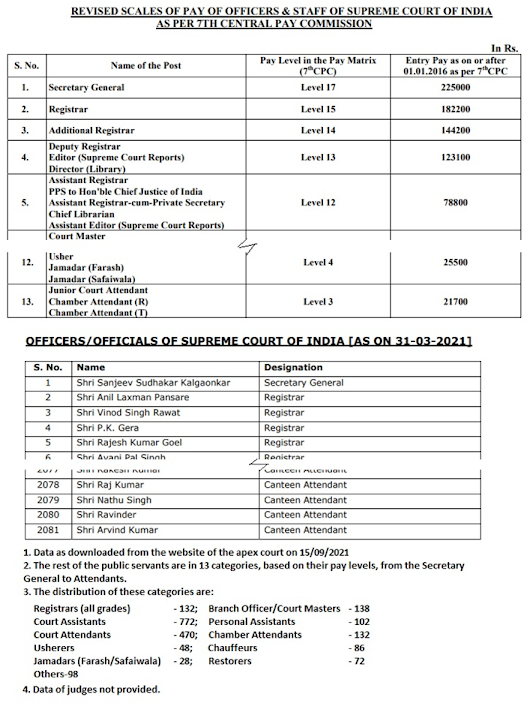
The data downloaded from the respective websites of the Kerala State Information Commission (KSIC), Central Information Commission (CIC) and the  Supreme Court (SC),  are shown in the screenshots 1 to 5 provided at the end of this part.  The facts to be noted are:

Ø  The KSIC had published the information correct enough to pass muster till 2011

Ø  The CIC had published the information correctly till 2012.

Ø  The apex court had not published the information pertaining to judges even in 2021.

Ø  The CIC has reduced its disclosure to practically nothing in 2022.

Ø  The KSIC has totally done away with disclosures mandated under Section4(1)(b) in 2022


Certain provisions of the RTI Act appear to be designed to subvert the law itself. It begins with the process of selection of the information commissioners. It is done by a committee of three comprising the PM/CM, another minister from the respective cabinet and the Leader of the Opposition. With the absence of a mandate for unanimity, the Leader of the Opposition is just a dummy in the selection process.


So far, I have come across just one case of such a selection process being challenged. This happened when a retired bureaucrat, P J Thomas, facing trial in the Palmolien Import Scam, was appointed as the Central Vigilance Commissioner. The apex court set aside his appointment in 2011. (But the case in which he is an accused is still pending. The alleged offence was committed in 1992.)


More importantly, the allegation of nepotism being hurled at the judiciary and its Collegium, is relevant in the case of these appointments too. It is generally bureaucrats who are closer to the power centers, who are seen making it as information commissioners and members of other quasi judicial bodies.


Given the fact that the task of the information commissioners is simpler than that of a munsif, the status, pay and perks given to them make it lucrative as sine cures for retiring babus; of course, at unwarranted and exorbitant cost to the exchequer.  


The law has explicitly barred certain information from being disclosed as well as kept certain organizations, as a whole, out of purview of the RTI Act. With that, all that the information commissioners have to do, on receipt of an appeal, is to ask just two questions beginning with: have all the information sought, which can be disclosed, been provided or not? If yes, have they been provided within the specified time frame? If not, is there any legally valid reason for the delay or denial? It is now for the information commissioner to get these reasons from the Public Information Officer, through a show cause notice. In the words of the law, be given a reasonable opportunity of being heard before any penalty is imposed on him.


The penalty is also specified-Rs 250/- per day of delay after 30 days of receipt of the application. 


However, what we find is that even when the information commissioners order the PIOs to provide the information that had not been provided, he desists from imposing the mandated penalty. It leads not only to subversion of the law but also to financial loss to the State. Worse, apprehensions of corruption also become wholly justified, not only in the broadest sense that Advocate Prashant Bhushan meant while alleging that 8 chief justices of India were corrupt, but also in its narrowest terms.  The subversion of law is to such an extent that even when no information has been provided the information commissioners brazenly record that all available information has been provided and close the case.


Let me narrate an example.


I was travelling by train to Thiruvananthapuram. I had only an RAC (Reservation against Cancellation) ticket but I was the first on the RAC list. That meant even if there had been just one cancellation I should have got a berth. However, even after one hour of the departure from the train there was no allotment of berth. So, when the TTE (Travelling Ticket Examiner) came around next time, I approached him with a request that I should be given a certificate that I had not been allotted a berth. The reason was simple. The RAC tickets are issued against full cost of a sleeper ticket, but when you are not allotted a berth it turns out to be just a sitting accommodation in the Sleeper Coach. So I wanted to claim refund of the excess cost and if denied follow it up with appropriate authorities.  Suffice to say that the TTE did not give the certificate sought but allotted a berth within the next 15 minutes.


Now, the issue could not be left at that. The objective of the RTI Act is to contain corruption and I wanted to check if anybody else had been allotted a berth before me (a sign of corruption, if not in its narrowest sense, surely in its widest sense). So I sought copies of the reservation chart with the data updated by the TTE.  Horror of horrors, the public authority, that is the Southern Railway Divisional Office at Thiruvananthapuram, demanded Rs 750/- per PNR number against Rs 2/- per page prescribed in the RTI Rules of the Central Government. The 2nd appeal filed on 16/04/2014 was dismissed by the information commissioner, Bimal Julka, on 14/07/2016.


Section 219 of the Indian Penal Code does provide for prosecuting such public servants and when convicted they are liable to imprisonment for 7 years. Just imagine what would happen if each information commissioner is prosecuted for every wrong verdict he delivers. But who will prosecute these delinquent and corrupt information commissioners when the judiciary takes decades to give verdict even in rape and murder cases?


There is also this unwarranted hurdle of seeking permission for prosecution of these treacherous public servants from others of their ilk. Just imagine the ridiculousness of the public needing to take permission from a public servant to prosecute another public servant. And even in the rare cases you get the permission, the public servant will defend his case at taxpayer’s money where as the complainant will have to drain his own resources. Great level playing field, isn’t it?


There have been cases where PIOs penalized by the information commissioners have appealed to the high courts, at taxpayers’ cost. In one such case at least, a high court had ruled that the appellant (the penalized PIO) will have to bear the expenses himself and tax payers’ money cannot be wasted on it. But, has any competent authority followed the logic and incorporated it in their rules?  To the best of my knowledge and belief, it is a definite no.


The RTI Act is a very simple and unambiguous law. It, to my mind, is the only pro-democracy and citizen friendly law in the country. It empowers the President (Sec 14(3)(d)) and the Governors  in the respective states (Section 17(3)(d ))to order removal of information commissioners who are, in their opinion, unfit to continue in office by reason of infirmity of mind or body.  But what do you do when these high offices act only as post offices? Let me narrate two instances.

A judgment published as 2004(3) KLT 1073 had observed that the President of the Kerala State Consumer Disputes Redressal Commission, a former judge of the same court, had mislead the court in the matter of the President having declared holidays for the Commission in line with the holidays declared by the High Court. Since no action for perjury had been initiated by the court a complaint was filed with the National Consumer Dispute Redressal Commission by an umbrella organization of consumer rights activists, Save Consumer Courts Action Council. Later an application under the RTI Act was submitted to get information on action taken on the complaint.  The reply advised the matter to be taken up with the Government of Kerala.  Since that could not be accepted as an action taken on the complaint the matter finally landed with the Chief Information Commissioner, Wajahat Habibulla. He, without applying his mind (not unusual with our babus), sent it to the Kerala State Information Commission. The fiasco was brought to his notice and the appeal was resubmitted. He, shockingly, forwarded it also to the KSIC. A complaint was submitted to the President to remove him under Section 14(3)(d) of the RTI Act. An application under the RTI Act for information on action taken revealed that it had been forwarded to the Department of Personnel and Training for action at their end and informing the complainant.


Similarly, a complaint was submitted to the Chief Minister of Kerala listing a number of defects and deficiencies in the functioning of the KSIC and requesting for action under Section 26 and 27 of the RTI Act. Of these, Section 27(2)(e) and (f) empowers the competent authority to prescribe the procedure to be adopted by the State Information Commission in deciding the appeals and any other matter which is required to be, or may be prescribed. This was important since the Commission was not even disposing of complaints and appeals on a first come, first served basis, leave alone directing delinquent PIOs to provide the information sought or penalizing them, as mandated by the law.  Unfortunately, after persistent follow up the only response received was from the Department of General Administration stating that since the Information Commission was an autonomous entity the Government cannot interfere in its functions. 


Can one imagine that there can be chaos even in the matter of language used? Section 6(1) of the RTI Act states that A person, who desires to obtain any information under this Act, shall make a request in writing or through electronic means in English or Hindi or in the official language of the area in which the application is being made. Now, should there be any doubt about the language in which appeals are to be submitted or replies are to be given? Just imagine a citizen from Delhi seeking information from a public authority in Kerala and applying in English and getting a reply in Malayalam. In any case, we are following a three language formula for our high school education and no public servant handling documents can be expected to be having education less than SSLC. But even in fully literate Kerala, it is common experience that most applications/appeals in English are replied to in Malayalam.


The malicious nature of functioning of the public authorities can be seen even in quoting the references to communications from the applicant /appellant. From PIOs to the Secretary of the Commission, they will only refer to the date of the application/appeal, sometimes not even the date mentioned in the document but the date of its receipt by the PIO/appellate authority, whereas they would refer to the complete file number and date of the communication from public authorities. (See Screenshot-6) Even specific requirement of quoting the file number is maliciously neglected by the PIOs and the appellate authorities.

The latest scam in the matter of implementing the RTI Act in Kerala is that the KSIC has devised a new, illegal and abhorrable means of disposing of complaints and appeals. One fine day the appellant gets a letter from the commission just referring to the date of submission of application and the public authority and seeking to know if the contentions averred in the appeal are persisting and if persisting it should be intimated to the Commission within 10 days, failing which the appeal would be closed. Adding insult to injury, on the letter head will be given an e mail id that does not work either.


There is more to the methods by which this simple pro-democracy, citizen friendly law is being subverted by the public authorities, including the information commissions and the courts.  More on this later.


P M Ravindran/ raviforjustice@gmail.com                                               05 December 2022


Screenshot-1. Disclosure under Sec 4(1)(b)(x) of the RTI Act by Kerala State Information Commission as on 01/10/2011

Screenshot-2. Disclosure under Sec 4(1)(b)(x) of the RTI Act by the Central Information Commission as on 14/05/12, accessed on 19/01/2014.


Screenshot-3. Disclosure under Sec 4(1)(b)(x) of the RTI Act by the Supreme Court of India

 Screenshot-4. Disclosure under Sec 4(1)(b)(x) of the RTI Act by the Central Information Commission as accessed on 04/12/2022

Screenshot-5. Disclosure under Sec 4(1)(b)(x) of the RTI Act by the Central Information Commission as accessed on 04/12/2022

Screenshot-6. Notice sent by Kerala State Information Commission to the FAA in my 2nd appeal.


JUDICIAL PERFIDIES-25


On 05 November 2022, a report at https://www.barandbench.com/news/not-satisfied-collegium-system-majority-judges-agree-with-me-law-ministerkirenrijiju informed its readers that the Union Law Minister, Kiren Rijju, had made a serious observation about the Collegium system. He had said: "The politics that we politicians do is nothing in front of the politics which happens inside judiciary. It is not visible but it is intense politics". 


I, for one, believe him totally.


I know how the apex court usurped the powers of the Executive to appoint judges to the higher judiciary. Nowhere in the dictionary could I find the word consultation as meaning advice of the consultee binding on the consulter.  It was the first step towards the constitution of the Collegium and a blatant subversion of the provisions of the Constitution. Nowhere in the world does such a system exist where judges appoint judges.


Another report, ‘People unhappy with collegium, govt should appoint judges: Law minister Rijju’,  (Oct 18, 2022 at https://www.indiatoday.in/india/story/people-unhappy-with-collegium-govt-should-appoint-judges-law-minister-rijiju-2286604-2022-10-18) says that  Rijju had also driven home another serious  issue: The executive and the legislature are bound and regulated by the judiciary. But if the judiciary goes astray, there is no mechanism to control it. Succinctly put, I must say. And this is the same idea I had been harping on for more than a decade now in the following words:

Among these three organs of our Constitution the law-makers are (theoretically, at least) controlled by the people, bureaucracy (yes, bureaucracy, because without the active support of the bureaucracy no politician can do any wrong!) and finally the judiciary; the law-enforcers, that is, the Executive, are also controlled by the law-makers and the judiciary. And then there are the ears and eyes of the people- the media waiting to sensationalize every news involving the misdemeanor of these authorities.

In spite of such strict supervision and control all that we can hear these days are about politician-bureaucrat-underworld nexus even though the fact remains that none, worth the name, from this unholy nexus have ever been punished by the holier-than-thou judiciary.

So now think how bad a system can be which is not only NOT subject to supervision but also kept beyond critical observation. Well isn’t our judiciary just that? And do I need to recapitulate that quip: power corrupts and absolute power corrupts absolutely?


Parliamentary Standing Committee of the Ministry of Law and Justice, then headed by Rajya Sabha member E.M.S Natchiappan, had said, 'Judges appointing judges is bad enough in itself; judges judging judges is worse.' This truism does not warrant any debate.


It brings me to the more important requirement of a National Judicial Commission to inquire into and punish judges for any and all offences, of omissions and commissions that are applicable to ordinary citizens. And, as the judiciary itself has been harping that unequals cannot be treated as equals, shouldn’t the punishment for the law qualified people be more severe than for ordinary citizens, typically, double for the lawyers and four times more serious for the judges.  However, a bill to constitute a National Judicial Accountability Commission has been gathering dust for decades now. And, with the apex court trashing even the National Judicial Appointments Commission Act will this bill ever see the light of the day?


The opaqueness in the judiciary’s functions is not a feature of the Collegium only. It was the first to begin subverting the Right to Information Act, with the Chief Justices, as competent authorities to frame rules, fixing Rs 500/- as application fee and Rs 5/- per page of photocopied information, against Rs 10/- and Rs 2/- respectively as fixed by other public authorities.


Also, we saw in Subhas Agarwal’s case, how the judiciary stonewalled providing information and the matter was decided against the public authority not only by the Central Information Commission and two benches of the Delhi High Court but also by a bench of the apex court itself. It is also pertinent that , it took the apex court almost a decade after the division bench of the Delhi High Court had given its decision, even introducing an unlawful provision that the Public Information Officers could seek reasons for seeking the information when the Act explicitly forbids it.


Horror of horrors, the Rules laid down by the respective Chief Justices have also kept the information about the judicial functions out of purview of the RTI Act.


To dig the last nail on transparency, the apex court has not even complied completely with the provision for suo moto disclosure mandated by Section 4(1)(b) of the RTI Act.


The yardstick I have been using to gauge transparency in a public authority is by seeking compliance with Section 4(1)(b), particularly with sub sections (ix) and (x) whereby the public authorities are required to publish a directory of its officers and employees and also the monthly remuneration received by each of its officers and employees, including the system of compensation as provided in its regulations.


Suffice to say, this has been a catalyst for subversion of this law by other public authorities, including the Information Commissions. To begin with, at least the suo moto disclosures of the Central Information Commission was a model that could be used as an example for other public authorities but now it has also been reduced to a farce.


Given the fate of this simplest of laws, which was enacted with the purported aim of containing corruption and to hold Governments and their instrumentalities accountable to the governed, it can easily be imagined what a mockery is being made of the other laws of the land. Isn’t it a common refrain that our laws are like cobwebs that trap insects and let the birds fly through?


I can vouch, on the strength of the decisions of the information commissioners of the Central Information Commission and the Kerala State Information Commission, that these commissions have been reduced to another cesspool of corruption, in its broadest meaning as accepted recently by the Indira Banerjee judgment in Advocate Prashant Bhushan’s contempt of court case. Obviously, it doesn’t rule out corruption in its narrowest sense either.


I am among those who believe that the RTI Act can be misused only by the information commissioners who can fail to impose the penalty mandated by Section 20 of the law without assigning reasons or giving false/misleading reasons.  And if this is not corruption, nothing can be.


I am also aware that this is an offence punishable under Section 219 of the Indian Penal Code which reads as whoever being a public servant, corruptly or maliciously makes or pronounces in any stage of a judicial proceeding, any report, or order verdict, or decision which he knows to be contrary to law shall be punished with imprisonment of either description for a term which may extent to seven years or with fine or with both.


Let me recollect two more facts brought out by the Law Minister (‘Why law minister Kiren Rijju wants a reboot of the collegium system of judges’ appointments, Sep 20, 2022; https://www.indiatoday.in/india-today-insight/story/why-law-minister-kiren-rijiju-wants-a-reboot-of-the-collegium-system-of-judges-appointments-2002484-2022-09-20)   

One, the vacancies have added to the judiciary’s burden, multiplying the case load—there are more than six million cases pending in the Supreme Court and high courts across the country. The rate of disposal of cases in the apex court has dropped from 67 per cent in 2018 to 25 per cent this year (till July 31). The disposal rate in high courts has dropped from 39 per cent in 2018 to just 9 per cent this year (till July 31). And,

Two, the delay (in appointment of judges) starts at the level of HC collegiums. While there were 380 vacancies in high courts till the end of July (between December 1, 2021 and July 27, 2022), the Supreme Court collegium recommended only 140 names (127 fresh and 13 reiterated) for appointments.


The Empire, nay, Judiciary, strikes back.


On November 11, 2022, a report (‘Supreme Court Issues Notice to Law Secretary Says- Keeping Collegium recommendations on hold is Unacceptable’) at https://lawtrend.in/supreme-court-issues-notice-to-law-secretary-says-keeping-collegium-recommendations-on-hold-is-unacceptable/ quoted a bench of Sanjay Kishan Kaul and AS Oka as having stated in its order that “Only the appointment must be issued after the second reiteration. Putting names on hold is not acceptable; it is becoming a tool to force these people to withdraw their names, as has happened.”


This, to say the least, is preposterous. The judges seem to be forgetting that the law making authority, as per our Constitution, is the Parliament and the legislative assemblies in the States. The courts are empowered only to interpret the law in the context of the facts of particular cases, where more than one interpretation is possible, subject to the framework, as outlined in its introduction or Preamble.


In practice, court orders are enforced only through follow up executive orders, even in cases where the judiciary is not a party to the case. That is why even after bandhs were held illegal by the Kerala High Court and that order was upheld by the apex court, they have continued to disrupt routine life in the name of hartals.  Interestingly,  the copies of the orders were denied to me by the Home and Law Departments of the Government of Kerala. The Kerala High Court itself denied them to me stating that they, being part of judicial proceedings, were out of purview of the RTI Act.


In the context of the current notice to the Law Secretary, I wish the Executive could reply that the Parliament has considered the recommendation and rejected it.


Another report that becomes relevant is the decision of the apex court to review its decision in the JMM bribery case. The report at https://timesofindia.indiatimes.com/india/1998-jmm-verdict-review-sc-to-examine-legislative-immunity-in-bribe-for-vote/articleshow/95543205.cms (‘1998 JMM verdict review: SC to examine legislative immunity in bribe-for-vote’, Nov 16, 2022) informs us that Nearly 24 years after a five-judge Constitution bench by a 3:2 majority held in the JMM bribery case that MPs cannot be prosecuted in a criminal court for allegedly taking bribes for voting in the House, a bench of same strength will now take a call on whether the 1998 verdict needs a relook and said that it would refer the case to a larger bench, if needed.

I personally believe that the 1998 verdict was flawed. But the logic that Parliament is not a place for trading in votes cannot be a new concept or a new moral high ground.  And it should apply not only to politicians but also judges, babus and public servants of every hue. In fact, JMM bribery case along with St Kitts case and pickle tycoon Lakhubhai Patel case, all involving the then Prime Minister P V Narasimha Rao, formed the triology of cases that I first began to analyze from the point of view of our laws, their interpretation by the judiciary and simple plain logic.  

For now, it is important to recollect that there was this cash at door step scam involving a judge of the Punjab and Haryana High Court.  On August 13, 2008, a bag containing Rs 15 lakhs was delivered at the residence of judge Nirmaljit Kaur. A three member committee was set up by the then CJI K G Balakrishnan and this committee drew an inference that the money delivered at the residence of Justice Nirmaljit Kaur was in fact meant for Justice Nirmal Yadav. As per a report dated 06 November 2021 at https://www.barandbench.com/columns/the-cash-at-judges-door-case-a-chronological-revisit (‘The Cash at Judge's Door case: A chronological revisit’) the trial of Justice Yadav is still inconclusive!

And that’s not all. The apex court is after the appointment of Chief Election Commissioner and Election Commissioners. ‘Need CEC who can’t be bulldozed, T N Seshan happens once in a while: Supreme Court’, reads a report, datelined November 23, 2022 (https://indianexpress.com/article/india/need-cec-who-cant-be-bulldozed-t-n-seshan-happens-once-in-a-while-supreme-court-8283854/). ‘‘Will ensure independence’: Supreme Court moots inclusion of CJI in consultative process for CEC appointment’, reads another one, of the same date, at https://www.financialexpress.com/india-news/will-ensure-independence-supreme-court-moots-inclusion-of-cji-in-consultative-process-for-cec-appointment/2887587/.  At this point can we forget how the apex court usurped the powers of the Executive to appoint judges of the higher judiciary by preposterously misinterpreting the meaning of the word consultation?  

A more interesting report is there at https://www.news18.com/news/india/total-recall-as-sc-questions-election-commissioner-goels-appointment-it-mustnt-forget-tn-seshans-fate-6464131.html (‘Total Recall: As SC Questions Election Commissioner Goel's Appointment, It Mustn't Forget TN Seshan's Fate’, November 25, 2022). It reminds the apex court as much as its readers thus: The Supreme Court is worried about the independence of the Election Commission and it is feeling the absence of a Chief Election Commissioner like TN Seshan. The only problem is that it’s the same Supreme Court that had made Seshan weaker by its decision when he was the CEC. (Order dated 14 July 1995 in WP(C) 805 of 1993)


Let me conclude this part with two quotes:  '...for judges of the Madras High Court and the Supreme Court, the PCA Act is a dog is a monkey is a bear is an elephant; intriguingly, a dog is also not a dog on another day.' (High Court and Supreme Court ‘jallikattu’ the PCA Act, Radha Rajan; 21 Feb 2012; http://www.vijayvaani.com/FrmPublicDisplayArticle.aspx?id=2195)


Already citizens are frustrated with the justice delivery system and only less than 10% of the litigants who have disputes are approaching the court," Justice Kirubakaran. (‘Rise in contempt of court cases irks Madras high court’, A Subramani; Feb 24, 2013; http://timesofindia.indiatimes.com/india/Rise-in-in-contempt-of-court-cases-irks-Madras-high-court/articleshow/18651932.cms?intenttarget=no)


P M Ravindran/ raviforjustice@gmail.com                                                   27 November, 2022